
For teachers
5 Jobs a Chant Does in an English Lesson
Rhythm work is sold as a memory trick. In a real room it does four specific jobs — and a fifth one that is never in the method books: it gets the class back.
A chant is a short line said to a steady beat, over and over, with one word changing. No melody is needed. Two claps and your voice are the whole apparatus.
It is the technique teachers like most and defend worst. Asked what it is for, most of us answer memory — which is the one claim the evidence supports least cleanly for chanting.
So here is the honest list. Four jobs a chant does well, one effect nobody expects, and three things it does not do at all.
What a chant actually does
1. It makes connected speech audible
The commonest complaint from a student at B1 is not vocabulary. It is that fluent speakers swallow words. They do not. They compress everything between the stressed syllables.
Did you eat yet arrives as three beats with the middle flattened to almost nothing. A student who has only met those words written as four separate blocks has no reason to expect that shape.
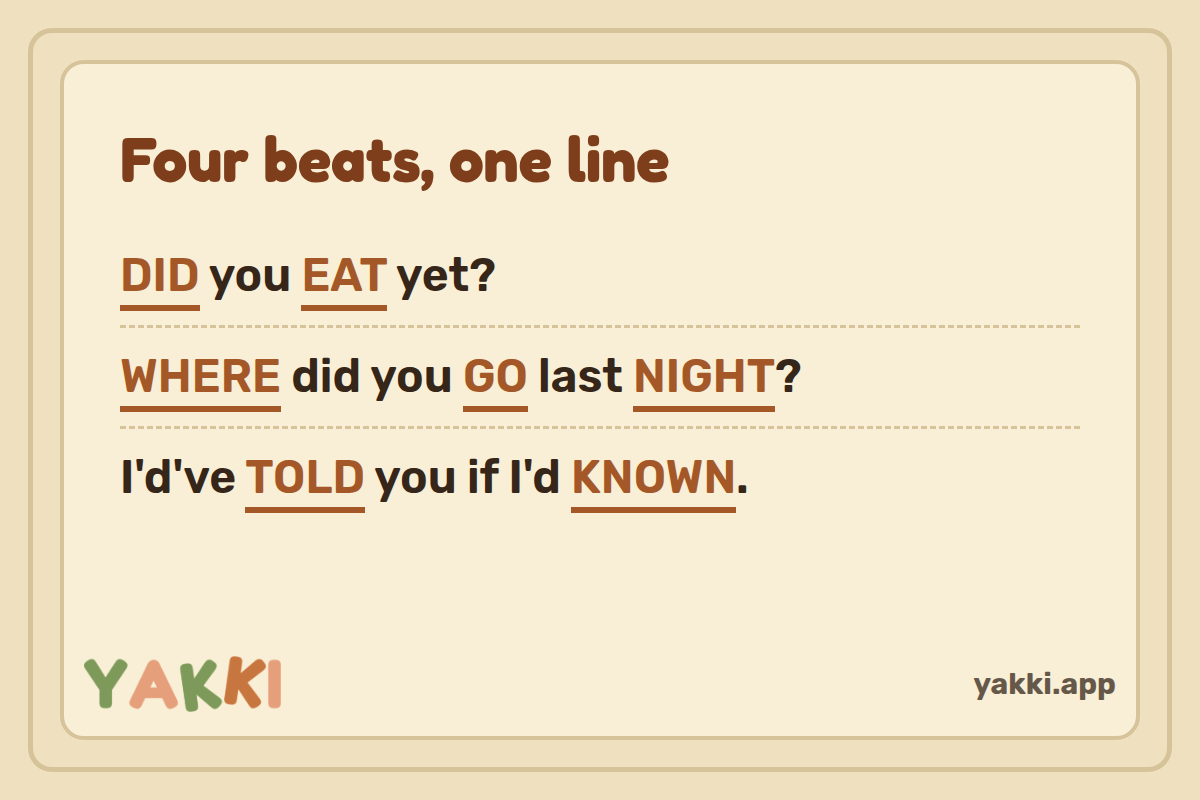
A beat fixes this without any explanation. You cannot keep the line inside four beats and still give every small word its full weight. The beat does the teaching.
2. It turns a pattern into one unit
Fluent speech is assembled from chunks, not from words picked one at a time. A fixed frame with one moving slot trains the frame as a single object.
She works at night. He works at night. They work at night. The ear is forced onto the one place that moves, and the rest stops being three words.
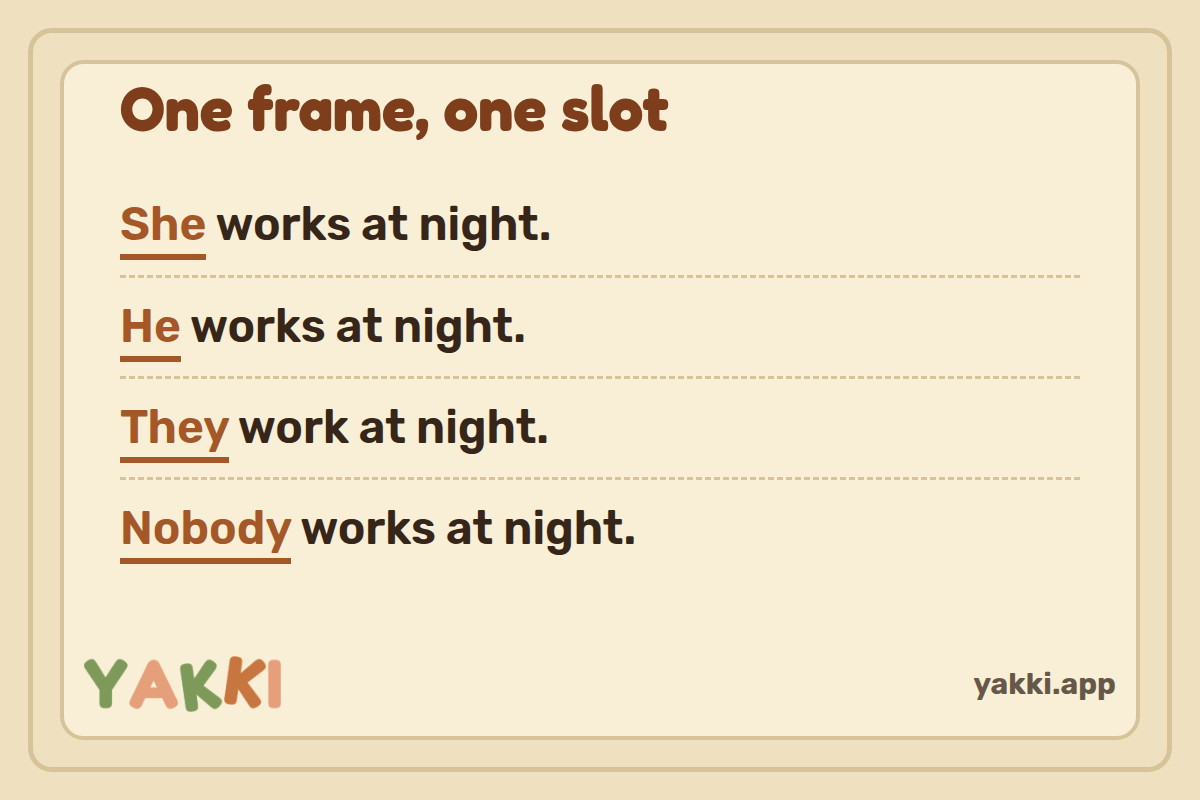
Then comes the half that matters: tempo. A fixed pulse removes the pause in which a student quietly assembles the sentence. That is why chanting shows up in fluency rather than in knowledge.
They already knew the rule. Now it comes out without the stop.
3. It buys repetitions you could not otherwise afford
This sounds like a footnote about motivation and is the practical core of the whole method.
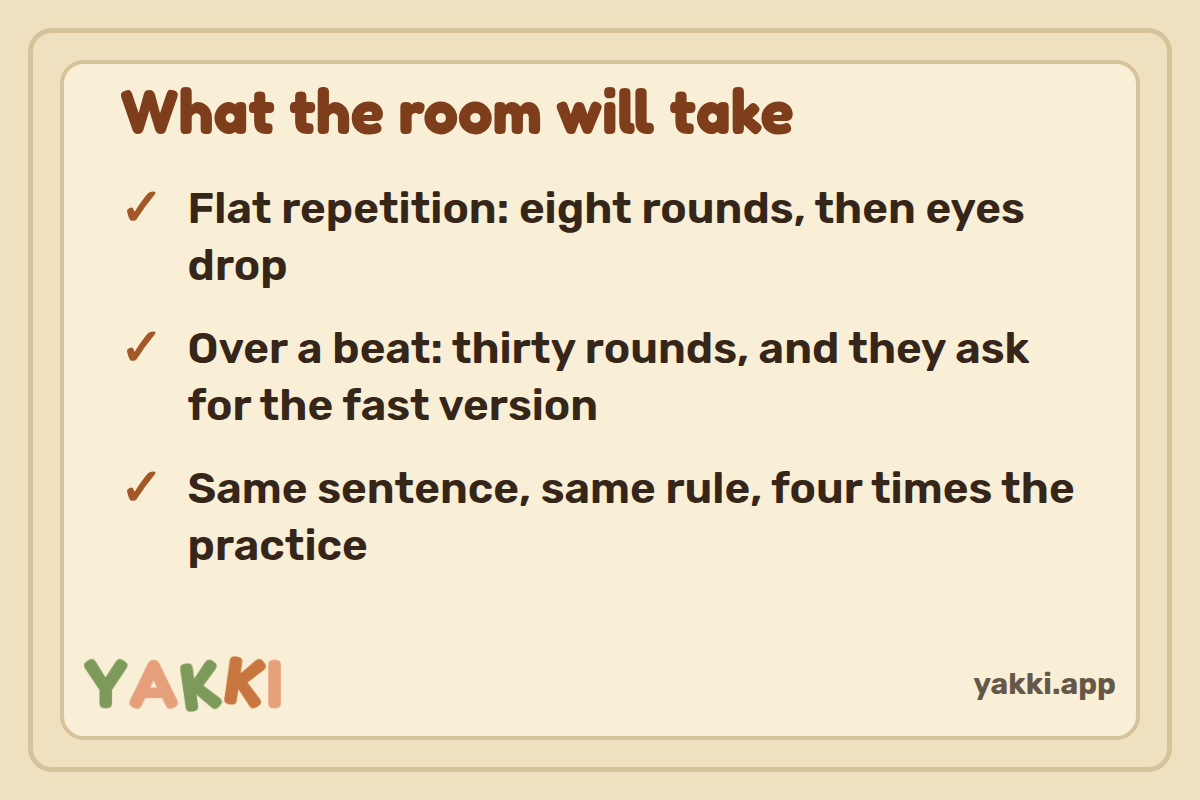
A form becomes automatic after a high number of repetitions. Plain drilling runs out of goodwill long before it runs out of usefulness. Thirty repetitions of I didn't go kill a lesson.
Thirty repetitions over a beat do not. The beat is what people will tolerate — and tolerance, not magic, is what the research on enjoyment of rhythm work keeps finding.
4. It gives stress something to be measured against
Rhythm is the one part of pronunciation where practice and marking line up. In free speech, too fast and wrong stress are opinions.
Over a pulse they become positions. The stressed word either landed on the beat or it did not, and the student can hear which — no ear training and no terminology required.
That is also why a chant can be corrected in public without anybody being embarrassed. You are not correcting a person. You are pointing at a beat that went by empty.
5. The one nobody expects: the room settles
This is not in the method books and it is the reason most teachers keep chanting after the novelty wears off.
A beat is a shared clock. The moment everybody is on it, side conversations have nowhere to sit: they fall out of time, their owners hear it, and they stop without being told.
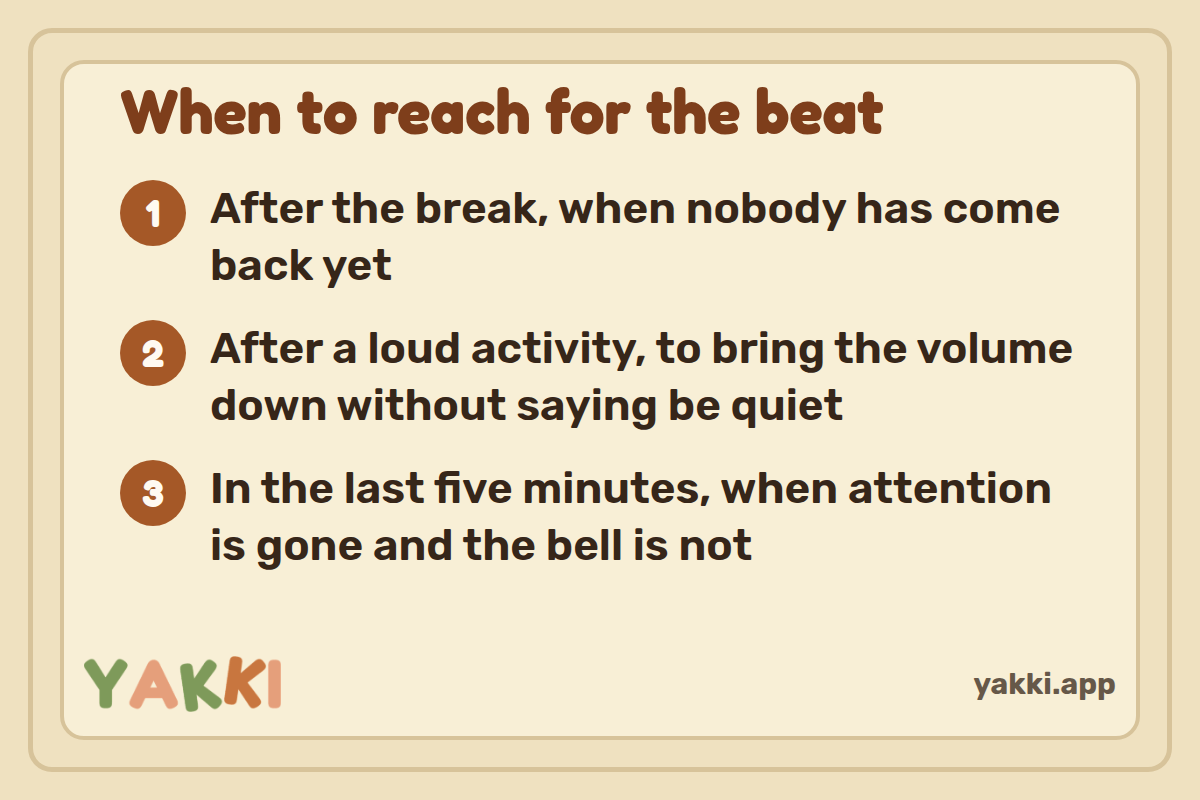
Three things make this work, and all three are easy to lose.
- You keep the beat, not them. Clap it yourself, or the tempo drifts up until the line collapses.
- Start slower than feels right. A beat that nobody can hit does the opposite job and makes the room louder.
- Stop while it is still working. Four rounds that end on a clean one beat ninety seconds that end in giggling.
Used this way a chant is a transition, not an activity. It costs ninety seconds and replaces the two minutes you usually spend asking for quiet.
What a chant does not do
It does not teach meaning. A student can chant a form perfectly and have no idea when to use it. The chant practises the form; the rule and the context go around it.
It does not replace knowing the rule. If the frame is the only thing learned, the student produces the chanted sentence and nothing else. The moving slot has to move often, in words they understand.
It does not fix sounds. If a learner cannot hear the difference between two vowels, keeping time will not install it. That is perception work and belongs in another exercise.
And one trap with teenagers and adults: the method is neutral, the material is not. A nursery melody makes an adult feel ridiculous, and they stop. Adult lines over an adult groove, or nothing.
A six-minute routine that fits any rule
The same six minutes work for every rule you ever drill. Change the line, keep the shape.
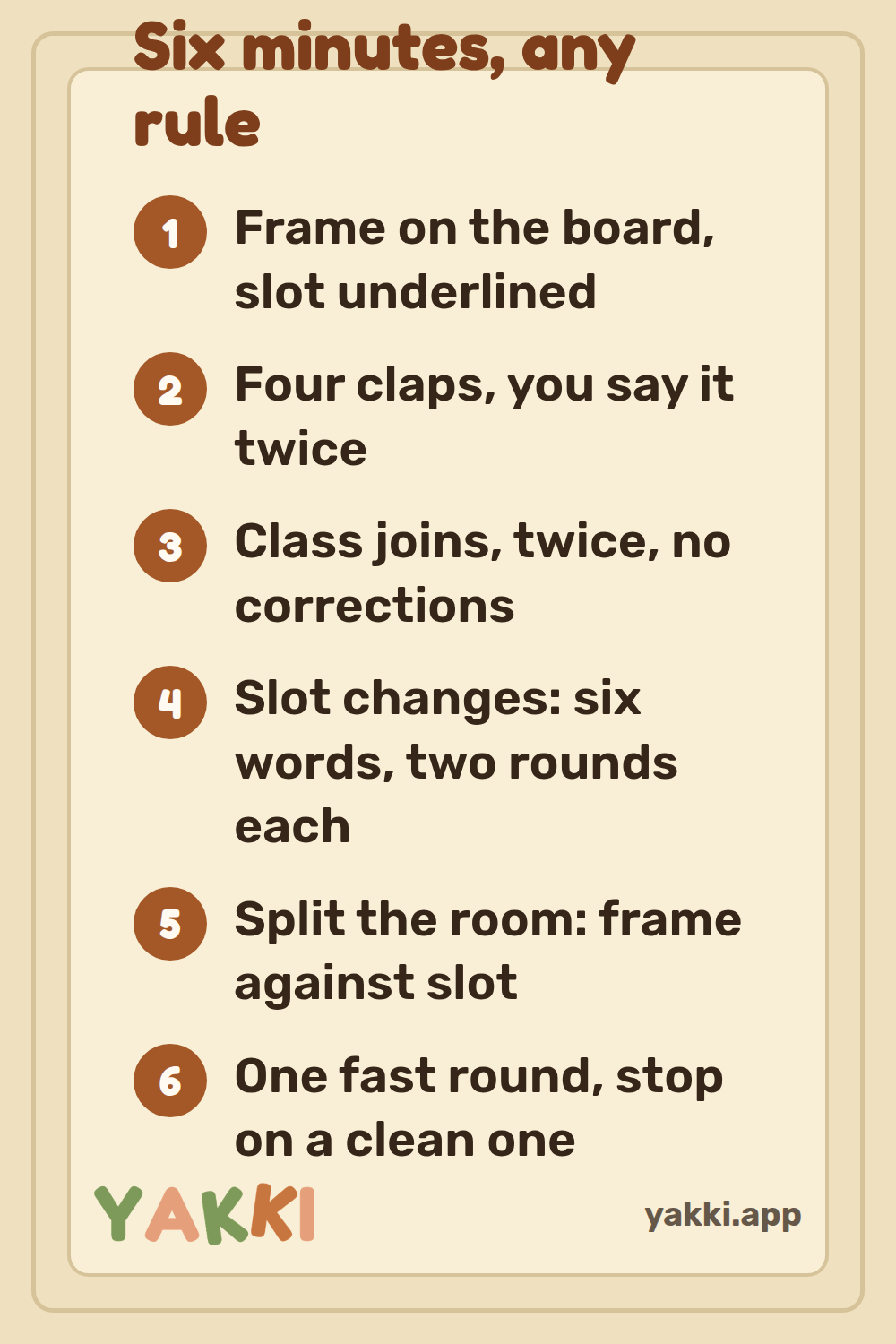
- Write the frame on the board with the moving slot underlined. One frame only.
- Clap four beats. Say the line alone, twice, on the beat.
- The class says it with you, twice. Do not correct anything yet.
- Change the slot. Two rounds per new word, six words.
- Half the room says the frame, the other half says the slot. Swap.
- One round at speed. Stop on the clean one.
Free lesson sheet: a chant lesson in 40 minutes
Two pages, A4. The six-minute routine, five chant activities with times, six mistakes the beat exposes, the signals that tell you to stop, and an empty grid for your own rules. No sign-up and no email.
Print it, copy it, give it to a colleague. If you need one for a rule that is not on it, write to [email protected] with the rule and the level.
Six chants you can use tomorrow
We have recorded six so far: the articles (a, an, the), was and were, am/is/are, am/are with a noun, the third-person -s, and the plural -s. One rule each, a minute or two long. Every one of them is below, and under each one is the rule page it drills.
They exist because of the fourth job on this list. A recorded beat holds the tempo steady when your own clapping starts to drift — which it always does by round twenty.
The honest summary
Rhythm work is a tool for timing, chunking, intelligibility and endurance, with a side effect on order that is worth as much as the other four in a full room.
It is not a shortcut to grammar and not a cure for perception. Used for the jobs it does, it earns its six minutes. Sold as a general promise, it invites a fact-check it cannot survive.
More for teachers
The rule behind the chant
Every chant above drills one rule. On yakki.app each rule has a page with the mistakes learners actually make and practice straight away — free, no sign-up.