
For teachers
7 Pronunciation Mistakes Your Students Make Because of Their First Language
Grammar yields to a rule. Pronunciation does not: the first language places the mouth before the student has finished thinking. Seven points, and how to hear which ones are in your room.
A student says He went to bet. You correct it, they repeat it correctly, and two sentences later it is back as bet.
That is not carelessness. Their first language devoices the end of a word, and the mouth settles that question before any rule arrives.
Which is why explaining does not fix pronunciation. Hearing the difference fixes it, and then saying it many times in short sentences.
Below are the seven points that travel furthest across first languages. For each one: what you hear, which languages produce it, and what to dictate.
Where the list comes from
Swan and Smith's Learner English gives chapters to first languages and to groups of languages, and each chapter opens with a pronunciation inventory in minimal pairs.
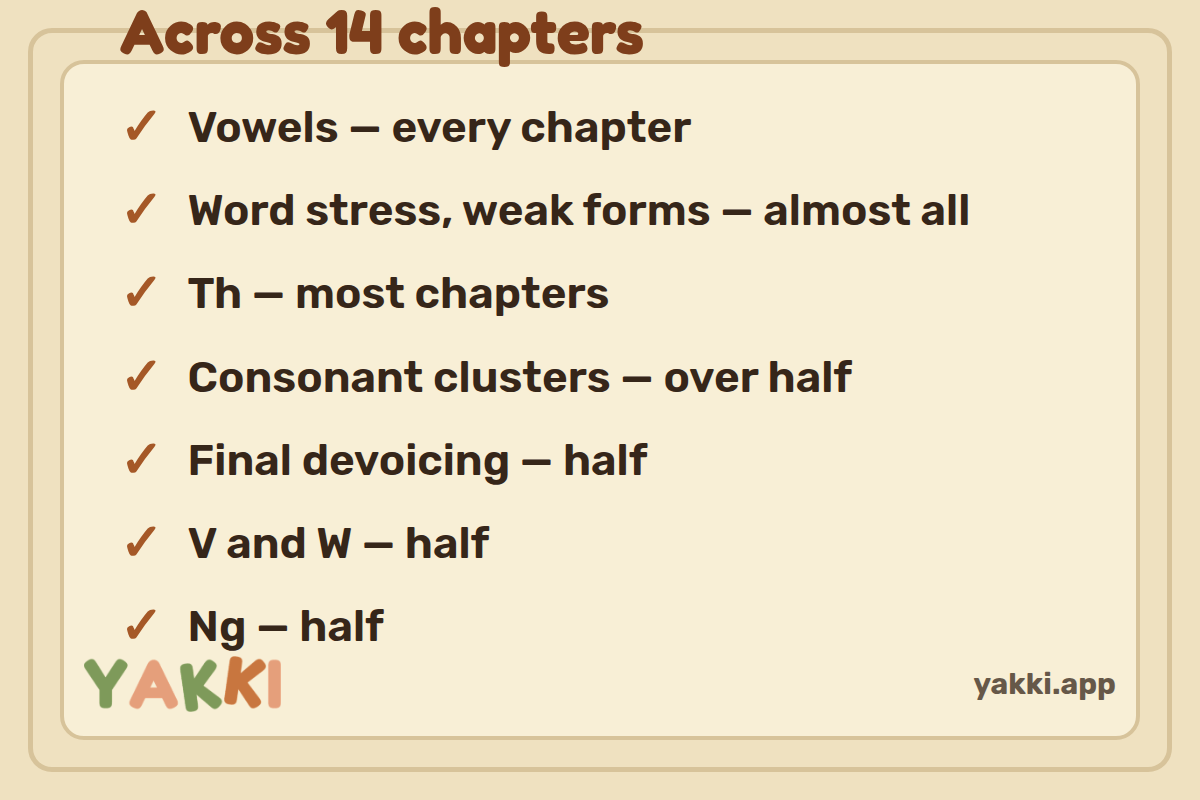
We read the pronunciation sections of fourteen chapters and ordered the points by how many chapters list each one, from the one every chapter has down to the ones about half of them have. The points and the word pairs come from the book. The spellings that show what you hear are ours: they are there so the sound can be seen on the page.
The seven
1. The vowels English separates
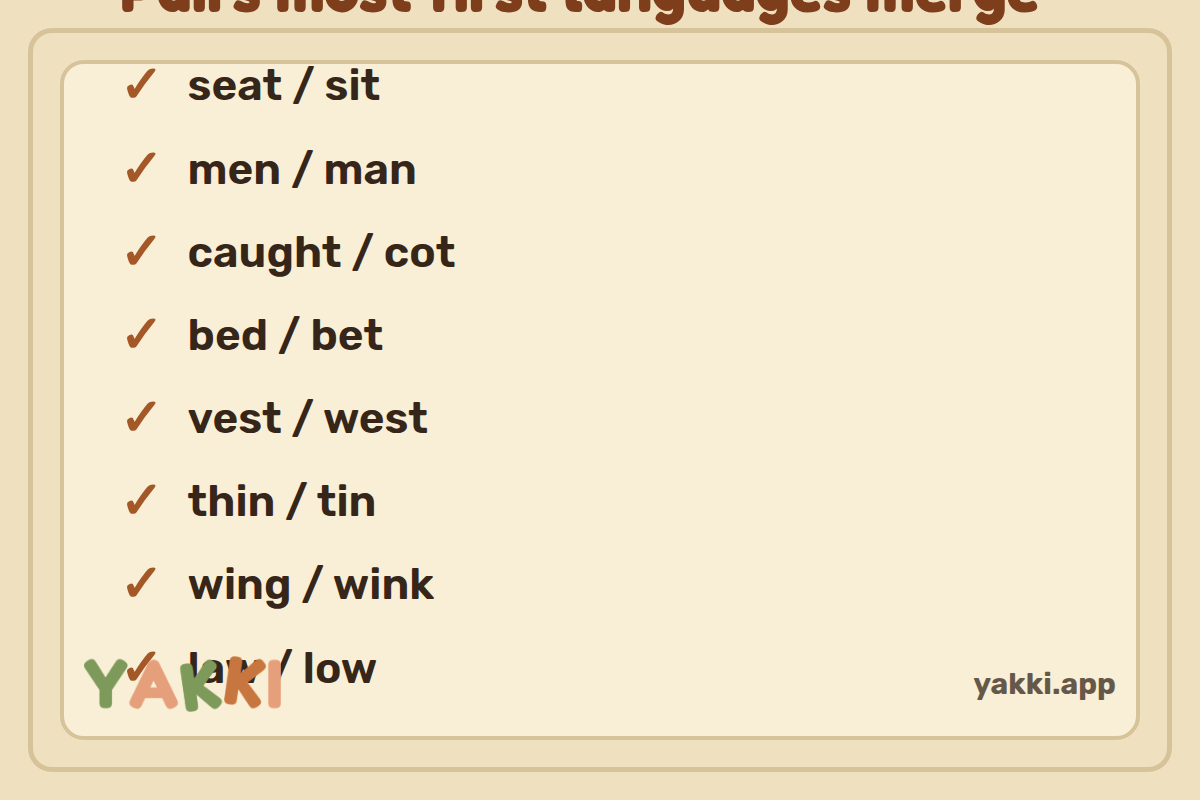
Every one of the fourteen chapters lists it. English separates vowels that most languages treat as one — some by length, some by how open the mouth is — so two words arrive as a single word.
- seat / sit, sheep / ship, keep / kip
- men / man, set / sat, caught / cot
Dictate the pair and ask for 1 or 2. If the dictation fails, repeating the correct form is pointless: the difference is not audible yet.
2. Word stress and weak forms
Almost every chapter. English moves stress when a suffix arrives, and the unstressed vowel goes weak. Where the first language keeps every vowel full, or keeps stress in one place, the pair collides.
- PHOtograph / phoTOgrapher / photoGRAPHic
- banana and political said with three full vowels
Mark the strong syllable on the board with a stroke. A visible mark does more than phonetic transcription, and it keeps working after you stop commenting on it.
3. Th
Most chapters, and each language picks a different substitute, so the teacher hears three versions of the same word around the room.
- think → sink, tink, fink
- that → dat, zat, vat
Three words are enough to start: think, this, the. Rare th words can wait until the common ones are stable.
4. Consonant clusters
Over half the chapters. A language that does not allow the cluster puts a vowel before it, or inside it, and the word grows a syllable. The two places need different work.
- spring → siprink, ispring; street → estreet
- film → fillum; milk → milik
In clusters that begin with s, glue the word to the one before it: the street, my school. The s moves back a syllable and the inserted vowel has nowhere left to go. A cluster inside the word is other work: slow and whole first, speed afterwards.
5. Final devoicing
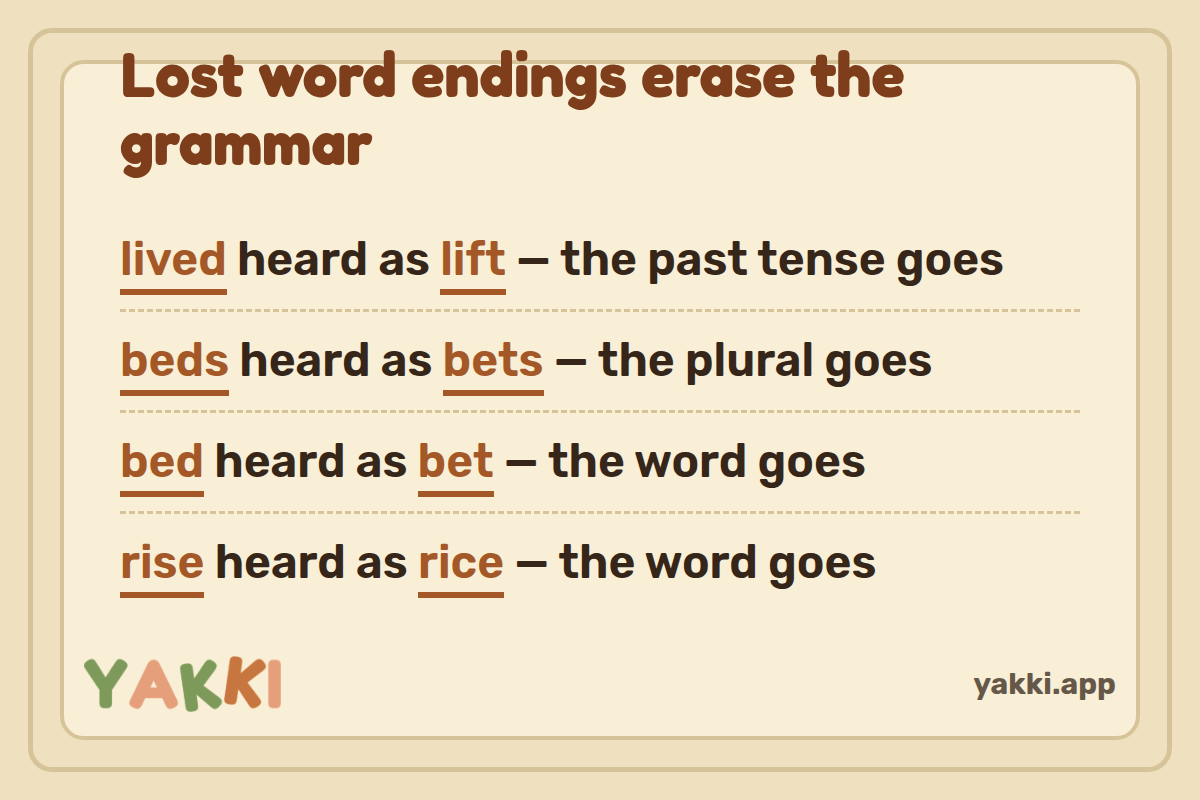
Half the chapters. The end of the word hardens, and what goes with it is not an accent but a tense and a plural.
- bed → bet, dog → dock, rise → rice
- lived → lift, beds → bets
Link the final consonant to a following vowel: bed is, lived in. The sound survives because it is no longer final.
6. V and W
Half the chapters, from both directions: some languages have neither sound distinctly, others have only one of the two.
- survive → surwiwe; while → vile
- vest / west, vine / wine
A mirror does more than ten explanations. The teeth must show on very and must not show on water.
7. Ng
Half the chapters. Either a hard g or k is added at the end, or the nasal collapses into n.
- singing → singingk; wing heard as wink
- sing heard as sin
Have them hold the last syllable: siiing, five seconds, mouth open. The sentence can come afterwards.
Which seven belong to your class
The list is drawn across fourteen languages. In your room only some apply, and knowing which saves half the correction.
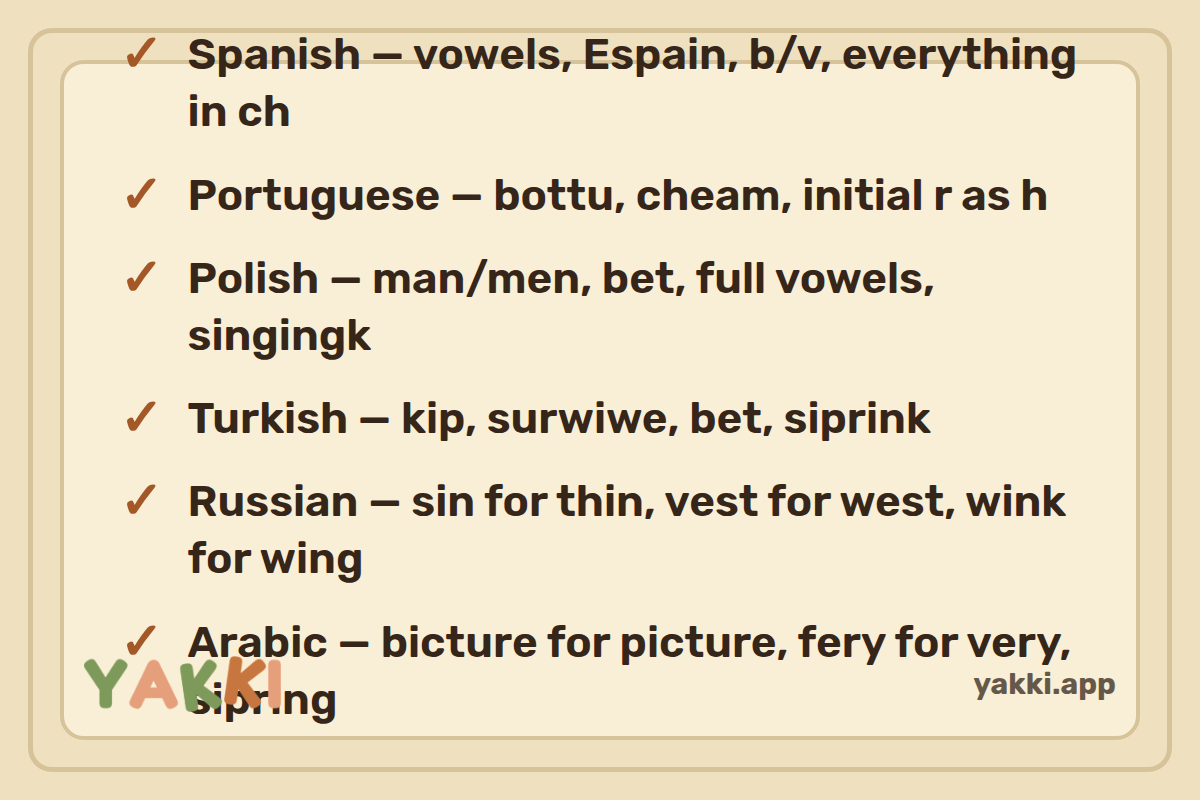
Spanish. The vowel pairs, the e before an initial s, b and v, everything ending in ch, cluster reduction and word stress.
Portuguese. Merged vowels, final l as u, team as cheam, initial r as h, final devoicing and the inserted vowel in clusters.
Polish. man and men, final devoicing, full vowels instead of schwa, th, ng with an added g or k, and shifted word stress.
Turkish. keep as kip, men as man, v for w, bed as bet, through with a t, spring as siprink and moving stress.
Russian. The vowel pairs, th as s or z, w as v, final devoicing, and wing collapsing into wink or win.
Arabic. p and b, v and f, and a vowel inserted into clusters: spring as sipring. The th sounds exist in Arabic, and whether a student replaces them with t, d, s or z depends on the dialect — listen before you put th on that class's list.
Why correcting alone does not move it
A correction assumes the student can hear the difference and chose not to say it. In pronunciation the opposite is usually true.
While keep and kip arrive as one word, repeating the correct form has no target. The ear comes first, the mouth after.
That is what dictation is for. Being wrong costs nothing there, and you can see at a glance which pairs the class separates.
Saying the goal out loud helps too. The aim is not a new accent: it is that neither the word nor the tense disappears.
How to use the list in class
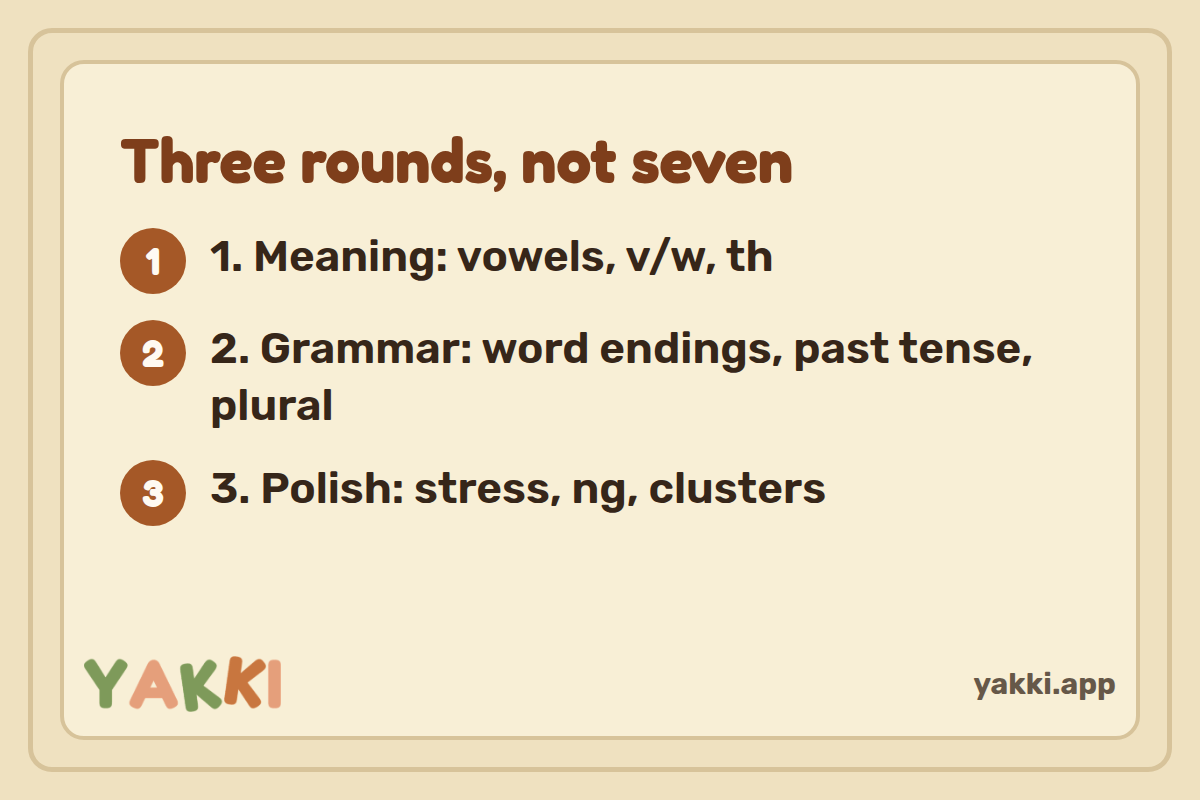
Seven points do not fit into one lesson. The order that works runs from what destroys meaning to what only marks an accent.
- Start with meaning: long and short vowels, v and w, th.
- Then grammar: final devoicing, the past tense, the plural.
- Leave word stress, ng and clusters for last.
Two minutes at the start of every lesson beats half an hour once a week. The ear works by repetition, not by explanation.
The seven-word dictation
One page. A ten-minute lesson: the seven words to dictate, what each first language produces in them, and a grid where you fill one row a week for the two points you keep. Print it and use it at the start of a lesson.
No sign-up. Print as many as you need.
The effect we did not expect
The dictation at the start of a lesson does more than open the ear: it quiets the room without anyone being asked to be quiet.
The reason is simple. Hearing the difference between keep and kip requires silence, and the task imposes it instead of the teacher.
The order builds itself: the class walks in, sits down and writes seven words. The lesson has started before the first explanation, because the signal comes from the sheet and not from the teacher's voice. There is a second effect. The dictation shows the class that being wrong is part of the work, because nobody is graded on it.
Three things this list is not
It is not a list of accents to remove. The goal is to be understood and to keep the grammar on the way, not to sound English.
It is not a full map of any one language. Each chapter in the book prints many more points; these are the seven that repeat across languages.
And it is not evidence about your particular class. The book says which points travel; only the dictation says which ones are in the room with you.
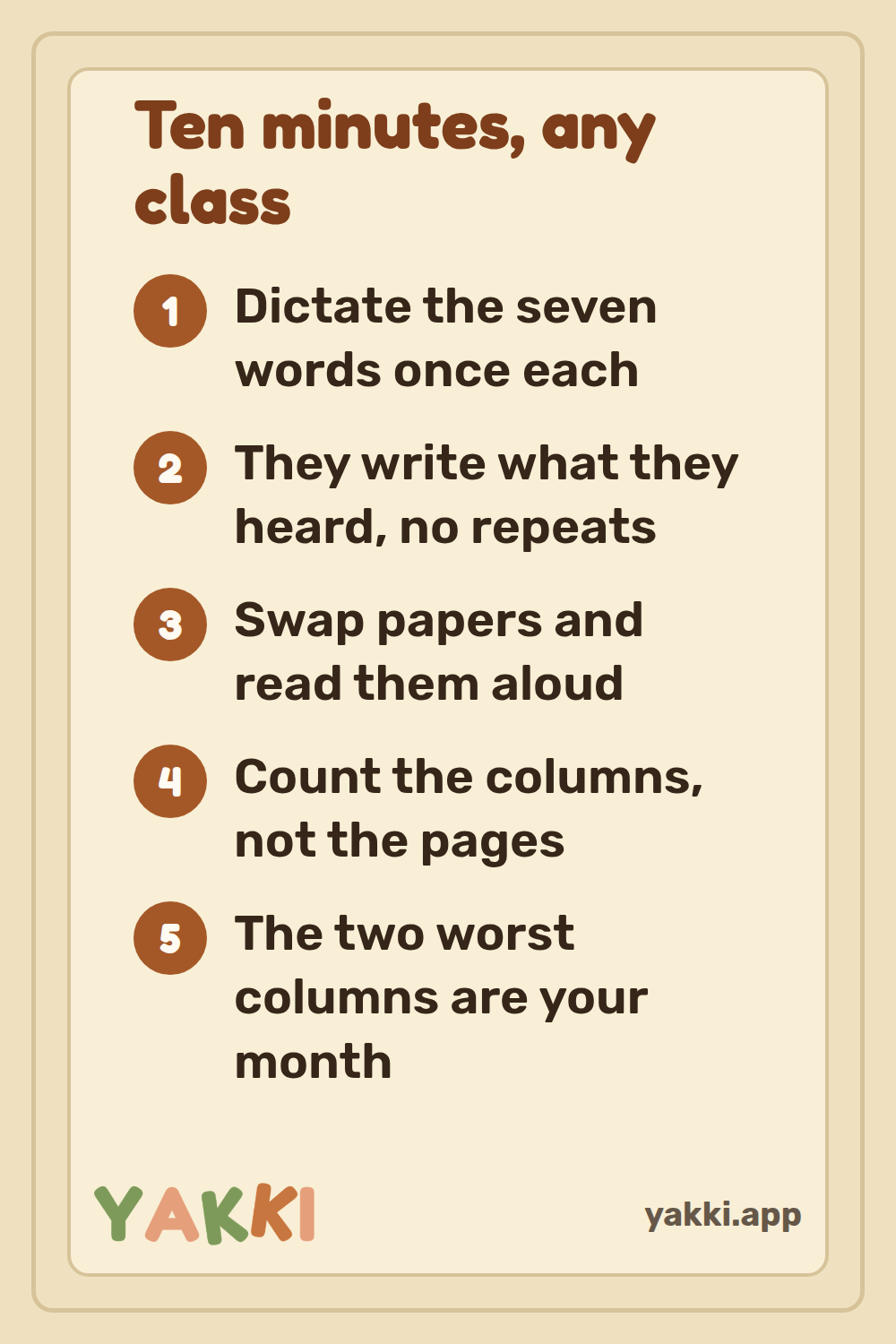
Seven points, one page, ten minutes. After that you are working on the two that matter instead of all seven.
More for teachers
Practice for the rule underneath
On yakki.app every grammar rule has its own page: the mistakes learners actually make, and practice that starts in one click. Free, no sign-up.