
For teachers
5 ESL Speaking Activities That Take 10 Minutes
Five short activities where the sentence comes from the student, not from the coursebook. A board, your voice and one rule they have already met.
A drill makes the class repeat a form. These five make them say something of their own with it, which is where the form either holds or falls apart.
They cost more than a drill. The sentences are unpredictable, the mistakes are new, and you cannot plan the answers in advance.
Each one takes about ten minutes and needs a board, your voice and one rule the class has already met. Every move is written out below.
None of them is a conversation lesson. The talking is short and tied to one form, because open conversation sends the class back to the three structures it already trusts.
Before you start
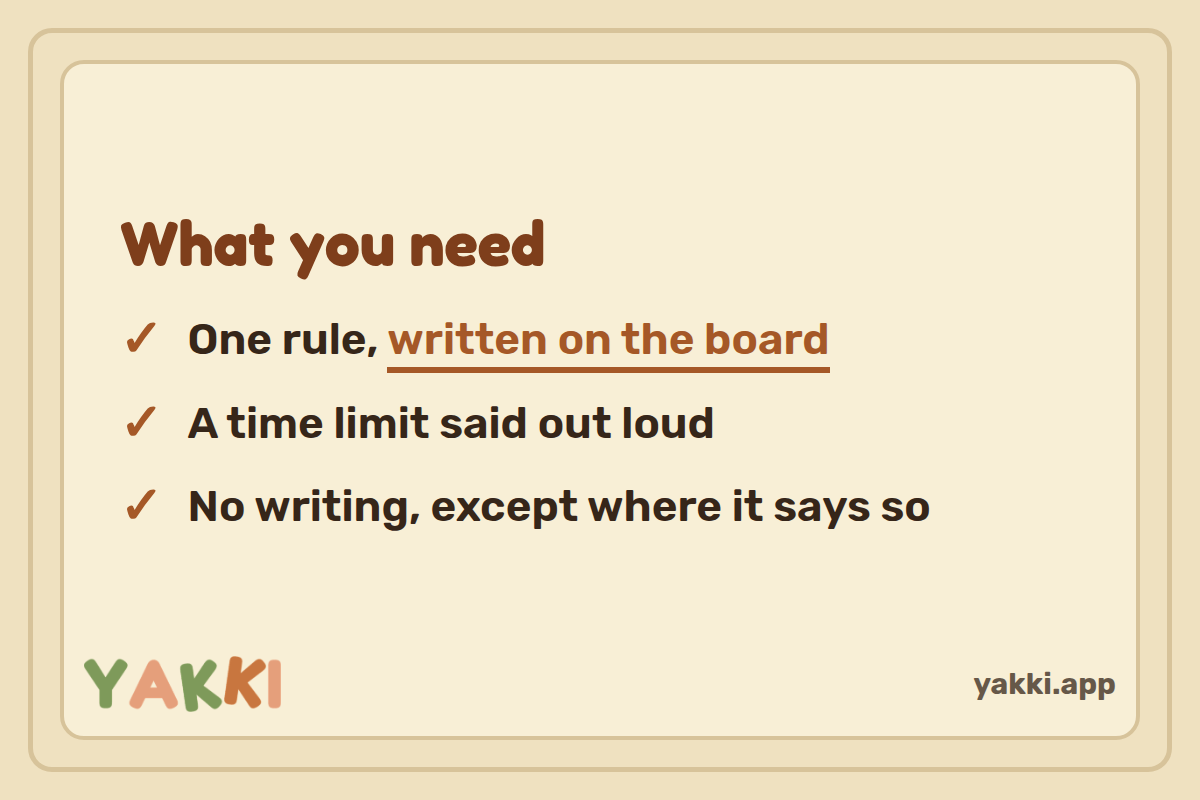
Set the rule and the tense out loud, and leave them written in the corner of the board. Without that, students answer in whatever tense is easiest.
Expect slower turns than in a drill. Ten minutes here is four or five students speaking properly, not twenty students speaking fast.
Three activities for the middle of the lesson
1. Two truths and a tense
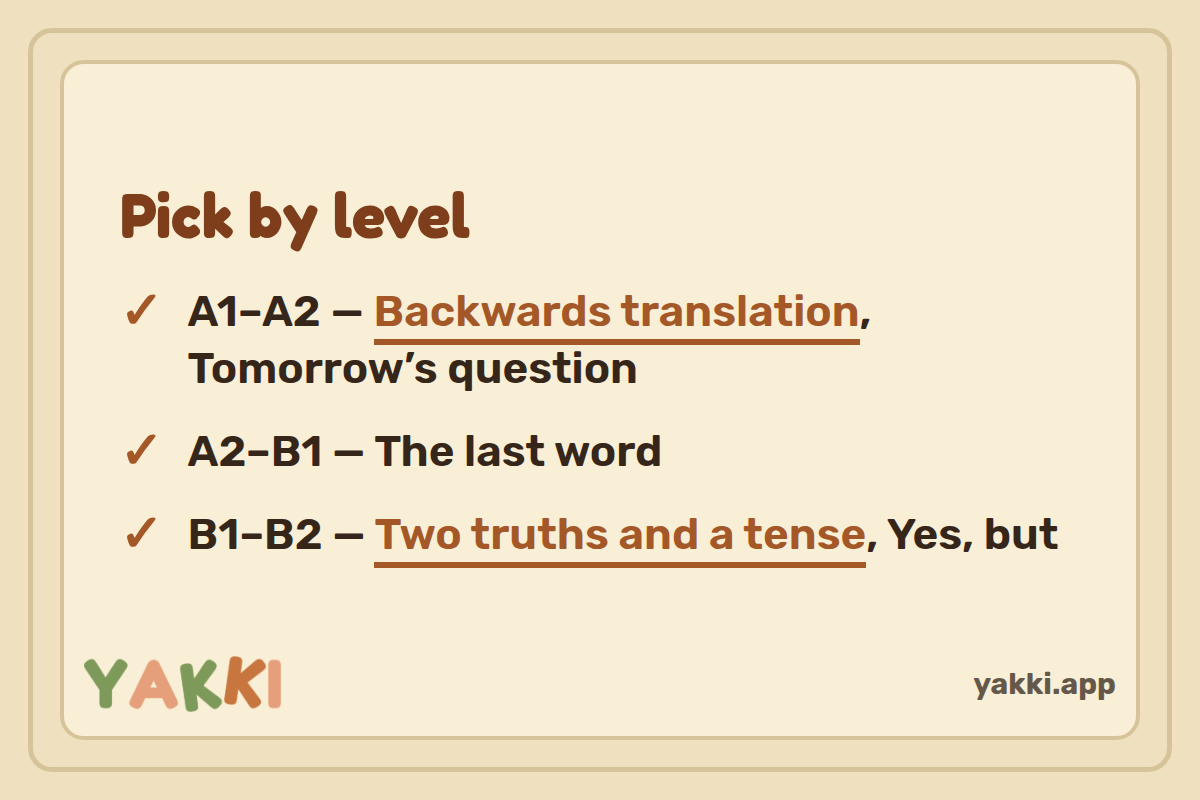
Each student says three sentences about their week. Two are true and one is invented, and all three have to use the tense you named.
Give thirty seconds to think and no writing. A prepared sentence is read, not spoken, and reading teaches nothing here.
The class guesses which one is invented, by show of hands. You say who was right, correct the grammar you heard, and move to the next student.
Go first yourself, with one invented sentence that is almost believable. That sets the size of the lie and saves a minute of explaining.
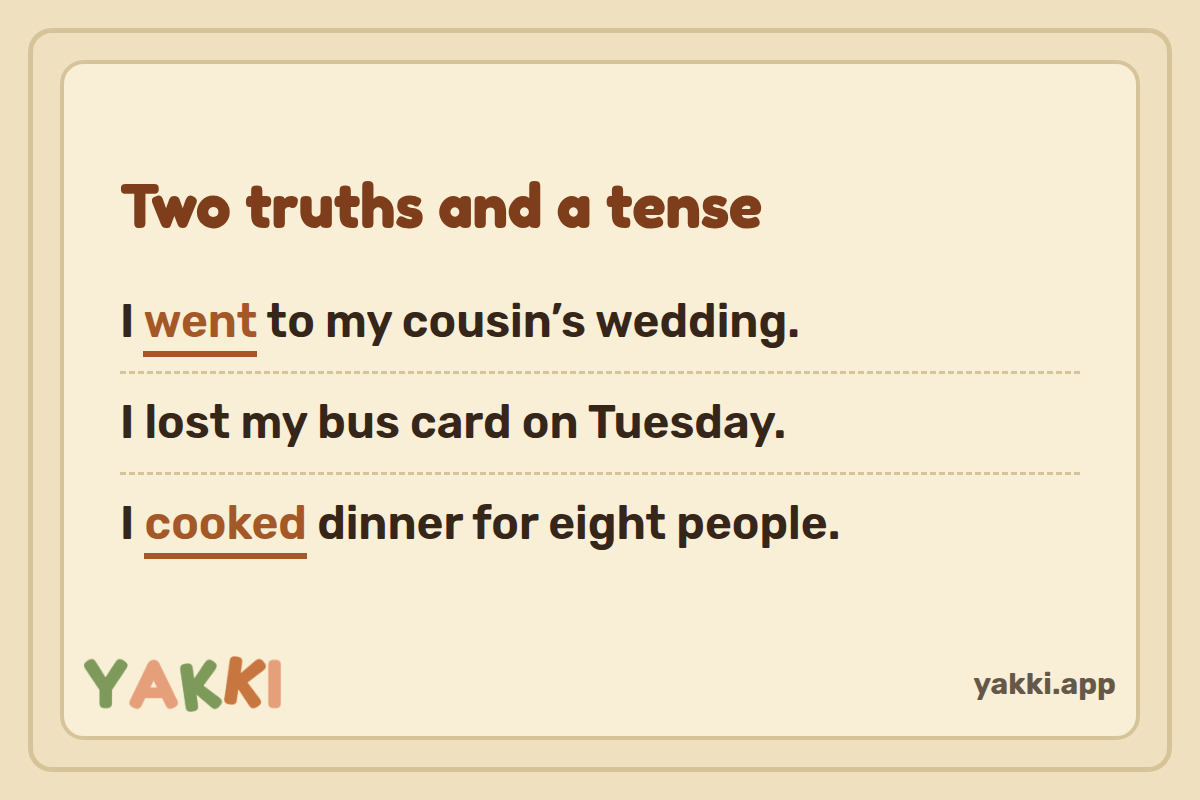
Set the tense before they start. Last week means past simple; this week means present perfect, and that difference is the lesson.
2. Yes, but
You make a statement. The student agrees with it, then adds a contrast using one connector that you name before the round starts.
Agreement first is deliberate. It removes the argument and leaves only the grammar: “Yes, I like winter, but the mornings are too dark.”
- One connector per round: but first, then although, then however. Three connectors at once teaches none of them.
- Works in pairs when the class is too big for turns.
Give the first contrast yourself. Students copy your shape for the next ten turns, which is exactly what you want them to copy.
Keep your statements small and true: the weather, the timetable, homework. A statement nobody cares about still gets a real contrast.
3. Backwards translation
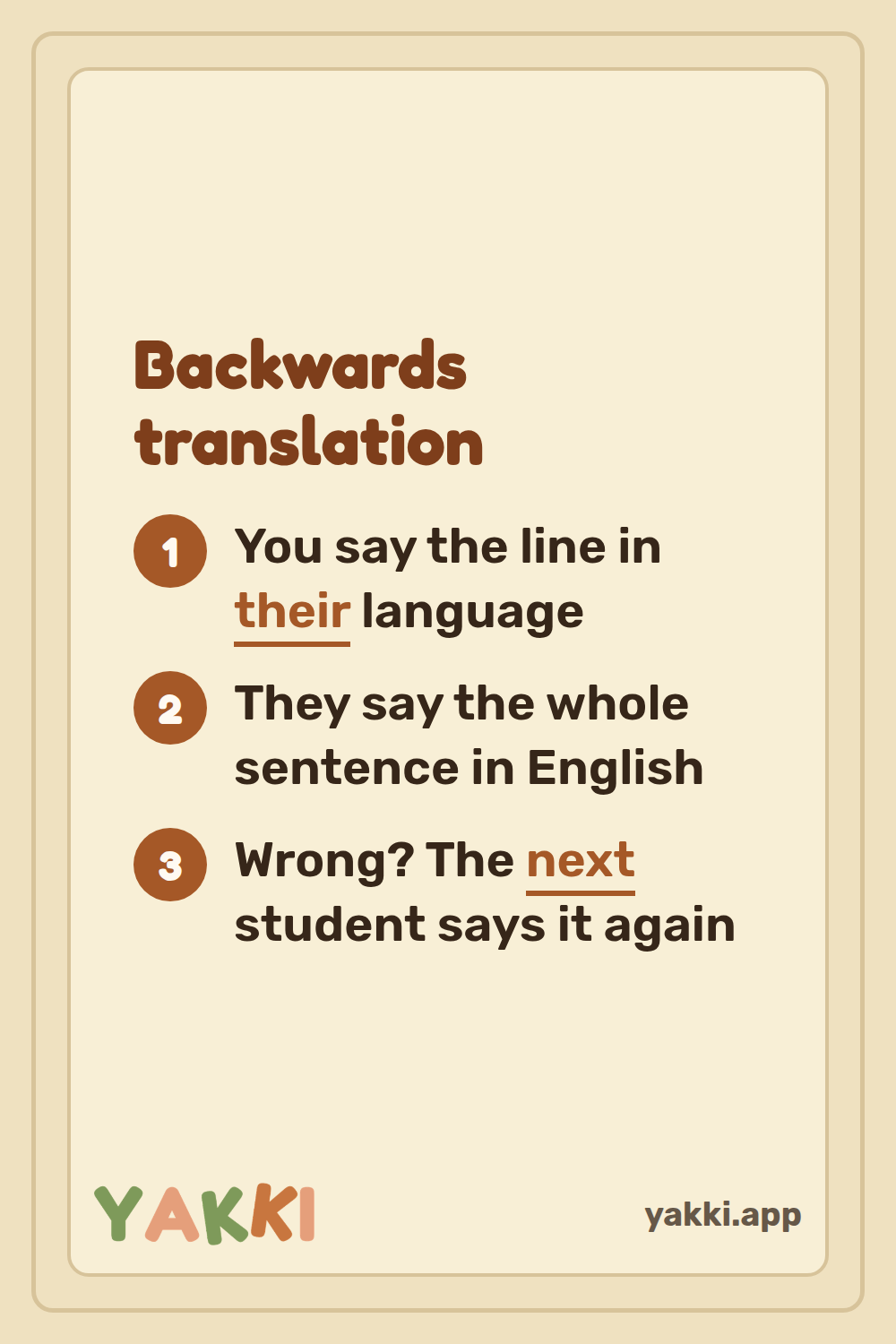
You say a sentence in the language the class shares, and they say it in English. Nobody writes anything down.
The first student to answer says the whole sentence, not a word of it. If it comes out wrong, the next student says it again rather than correcting the first.
This is the one activity that needs a shared first language, and a teacher who speaks it. In a mixed class, show a picture instead of saying a sentence.
Use sentences they will actually say. A line from the corridor beats a line from the coursebook.
Three students is usually the whole round. Stop while the class still wants a turn, and the next time you name the activity nobody groans.
Two activities for the last five minutes
The end of the lesson is the cheapest place to make students produce something. The rule has just been taught, and nobody has to be warmed up.
4. The last word
Everyone writes one sentence using the rule of the day. Thirty seconds is enough, and the deadline keeps the sentences short.
Collect the papers face down and read the sentences out without names. The class votes for the best one, not the most correct one.
Then put the mistakes that came up more than once on the board and correct those, not the writers.
- Reading without names is what makes it safe.
- The weakest writer hears their line read out like everyone else’s.
Keep the papers. Read them again before the next lesson and you have the list of what the class actually did with the rule.
5. Tomorrow’s question
The class writes one question for you, using today’s rule. They argue about the wording, which is the point, and hand you one agreed question.
You answer it at the start of the next lesson, out loud, in two or three sentences.
It costs you two minutes tomorrow and buys the rule a second meeting. That second meeting is where it starts to stay.
Write the agreed question on the board before they leave, mistakes and all. Correcting it together at the start of the next lesson is half of tomorrow’s warm-up.
Free lesson sheet: Present Perfect in 40 minutes
Five speaking activities strung into one lesson on a single A4 page, with the board lines, six mistakes to listen for and the stop signals. The second page is yours to fill. Free to print and to copy. Soon you will be able to build a sheet like this for your own rule on yakki.app; if you need one now, write to [email protected].
The drilling half is here: 6 Grammar Games That Drill One Rule in 10 Minutes — read it.
Correcting without stopping the talk
Every correction you make during a turn costs you the next two students. They heard what happens to a volunteer and decided to wait.
Write what you hear instead. Two or three words in the corner of the board, no names, and come back to them when the round is over.
Correct the mistake that came up twice. One student’s slip is a slip; the same slip from three students is the next ten minutes of your lesson.
The exception is the target rule itself. If the form you named is wrong, say it at once, in three words, and give the turn back to the same student.
When nobody speaks
Silence in a speaking activity is not shyness as often as it looks. Usually the rule is not there yet, or the question has no answer worth giving.
- Nobody answers at all: go back to a drill for five minutes, then try again.
- Answers of two words: your prompt has a two-word answer. Ask about a week, not about a fact.
- Everyone speaks their own language: the activity is too hard, not the class too lazy.
- One student carries the whole room: move to pairs, and keep the time limit.
Correct what you heard twice, not everything you heard. A list of three mistakes at the end is worth more than thirty corrections during.
More for teachers
Practise the rule, not the activity
Every activity above rests on one rule. On yakki.app a rule page gives you the mistakes people actually make and practice right away — no sign-up. Thirty-one rules have an English clip today.