
For teachers
6 Grammar Games That Drill One Rule in 10 Minutes
No printing, no apps. Six games you can run with a board and your voice, each one written out move by move.
Ten minutes is the time you actually have. Not a lesson plan. The ten minutes before the bell, after the test, or when the projector dies. Those ten minutes are usually spent on nothing.
Every game here needs a board, your voice and one rule the class has already met. Nothing has to be printed before the lesson.
All six are drills. The sentence stays short, the form comes back again and again, and the win is speed: a correct sentence said without stopping to think.
Each game is written out move by move. A game you have to invent halfway through stops being a game and turns into a quiet worksheet.
What you need before you start
A game without a target rule is just noise. Decide the rule first, then pick the game that fits it. Write the rule in the corner of the board and leave it there.
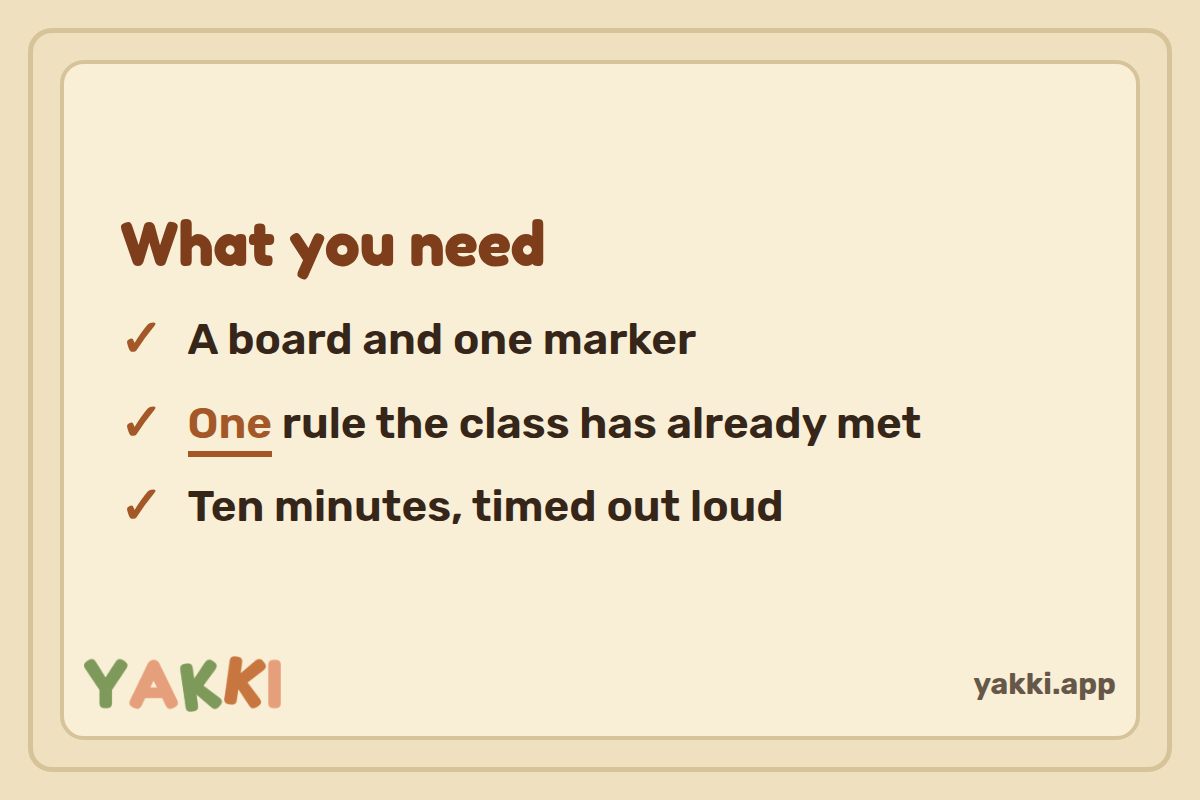
Say the time limit out loud before you begin, and keep the score on the board if the game has a winner. Nothing goes on paper.
Sit the class in a circle if the room allows it. Turn-taking collapses when half the class is facing the wrong way.
Three games for the first five minutes
1. Wrong on purpose
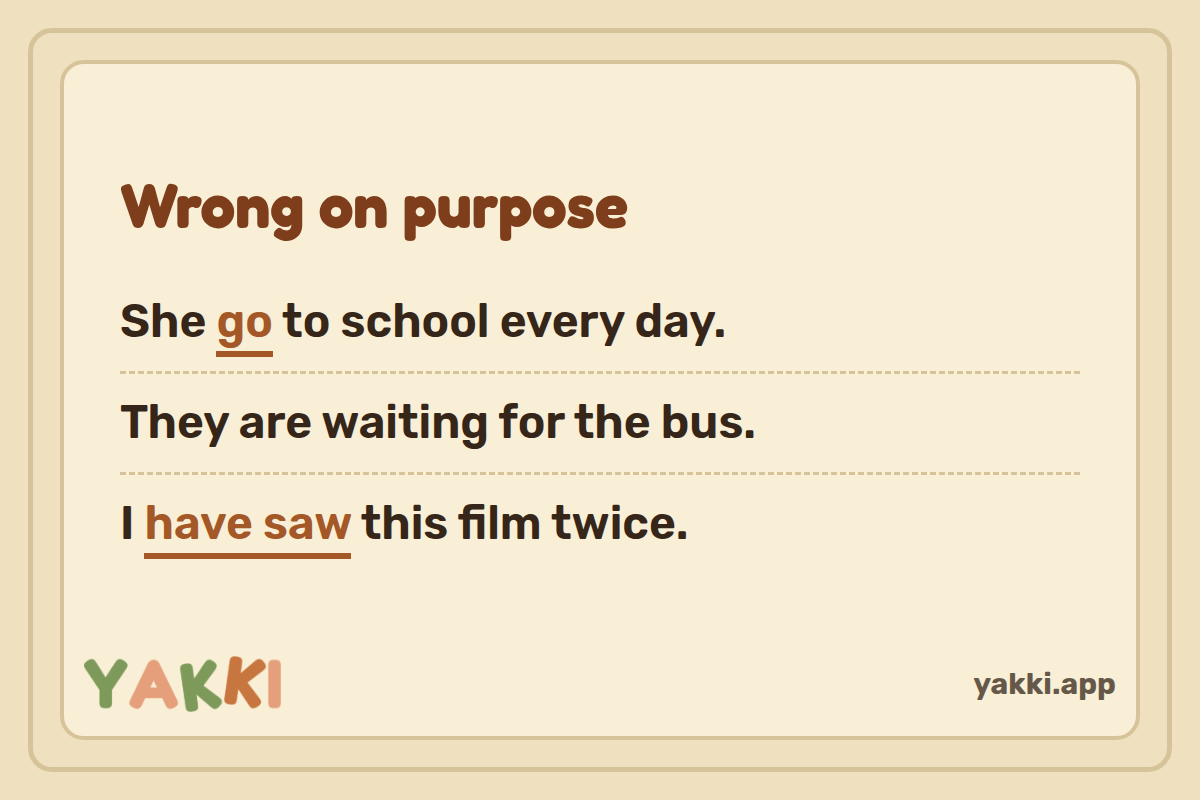
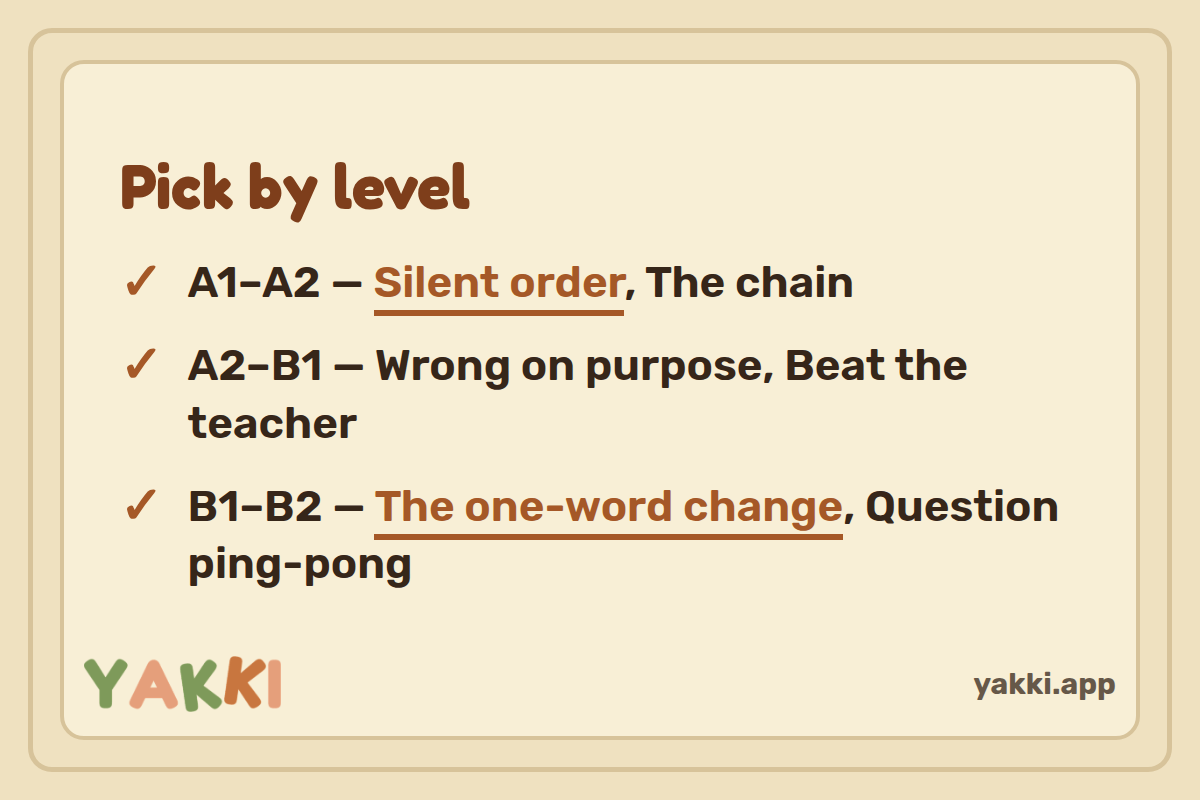
Drills: spotting a broken form. You say one sentence out loud with exactly one mistake in it, and the class hunts for it.
Hands up. The first student to name the mistake says the sentence again, correctly. That student then says the next sentence, with their own mistake hidden in it, and the hunt starts again.
- Works from A2 up, and best for word order and tense.
- Keep your mistakes small. A silly sentence is spotted by sound, not by grammar.
- Stops working after about eight rounds, so switch before it dies.
It works because finding a mistake is easier than making a sentence. Weak students join in on the first round. Take your mistakes from the ones you actually heard this week.
2. The chain
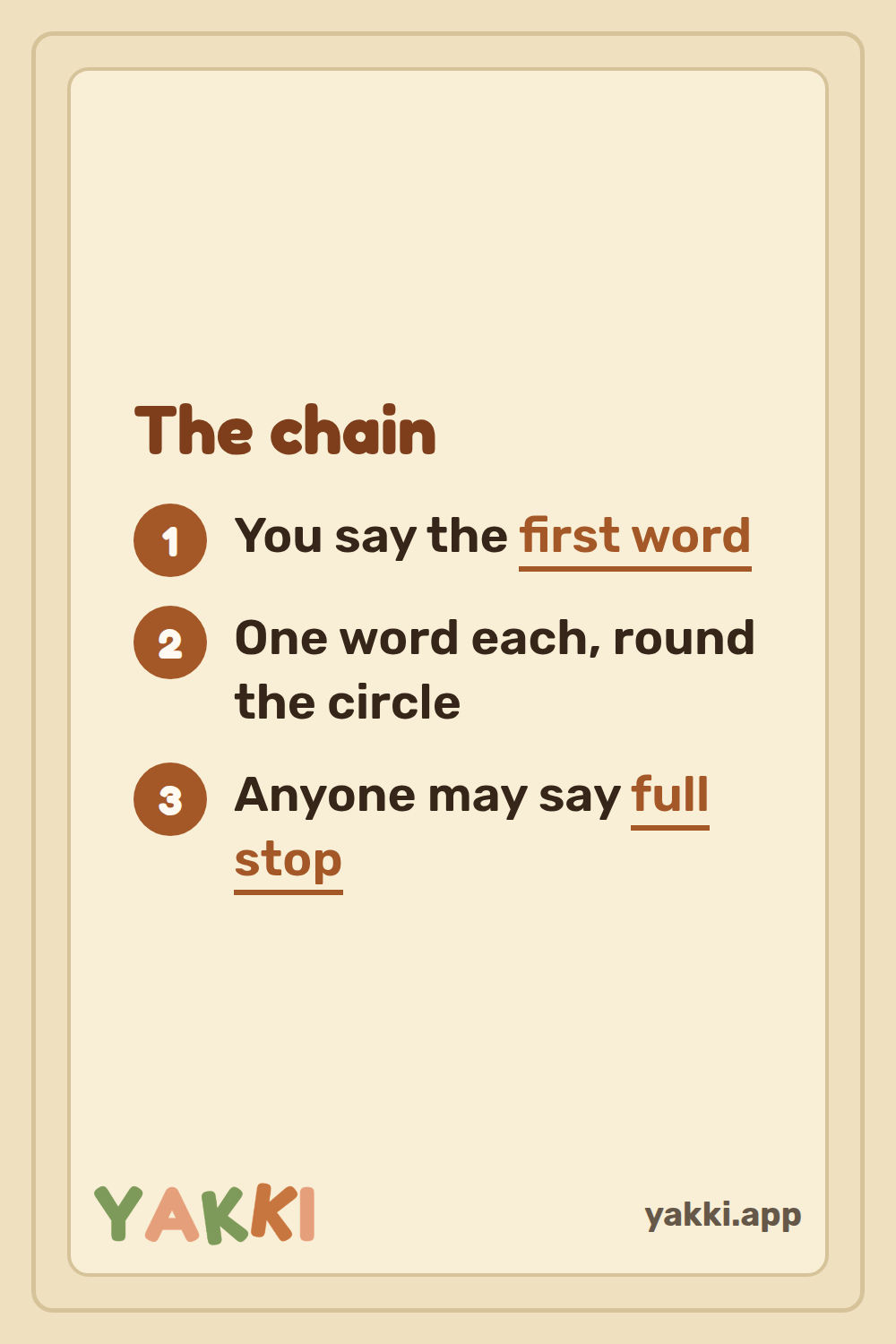
Drills: word order under time pressure. The class builds one sentence, one student at a time, one word each.
You say the first word. The next student adds one word that keeps the sentence possible, then the next, around the circle. Any student may end the sentence by saying “full stop”.
Nobody may think for more than three seconds. Count the seconds on your fingers, not out loud, so the counting does not eat the turn.
When the chain breaks, start a new sentence from the student who broke it. Nobody is out and nobody waits, which is why it survives a tired class.
3. Silent order
Drills: word order, with every student answering at once. Write one sentence on the board with the words scrambled, and number them: 1, 2, 3, up to eight or ten.
Ask which word comes first. The class thinks in silence, and on your signal everyone raises the number of that word on their fingers at the same moment. Six to ten take two hands.
You see every answer in one look. Write the winning word on a clean line, ask for the second word, and carry on to the end of the sentence.
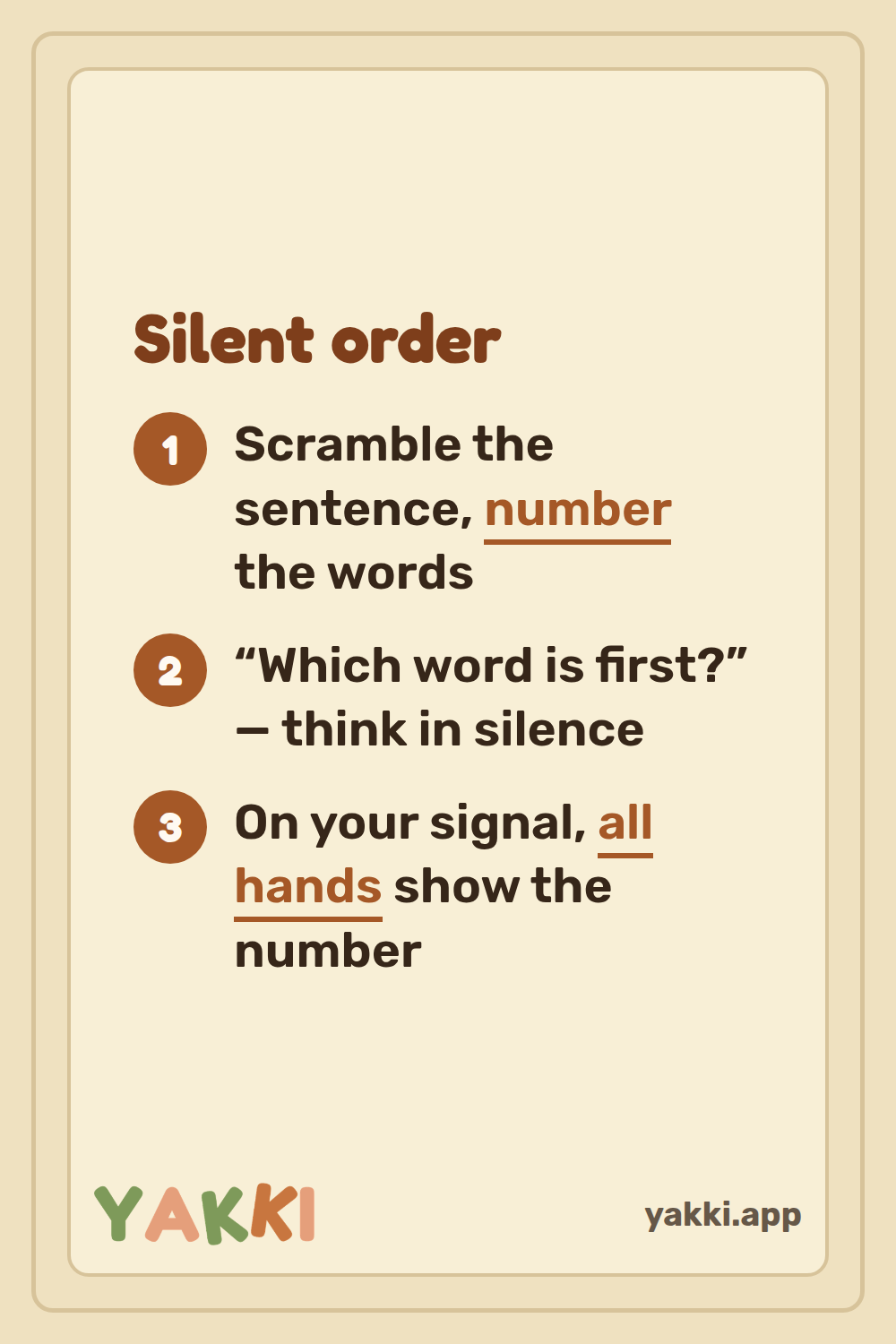
The silence is the mechanism. Nobody can answer for the class, and the student who is always first has no advantage.
Eight to ten words is the right length. Shorter has no puzzle in it, longer turns into arithmetic.
Three games for drilling one form
4. Question ping-pong
Drills: question forms. You say a statement. A student turns it into a question, and then gives you a statement back.
The question half is the work. The auxiliary has to be found and put first, and the main verb drops back to its plain form: “I went home” becomes “Did you go home?”
- Best for do, does, did, have and will.
- Keep the pace fast. A slow round teaches hesitation.
Once the first round is over, the statements come from the class, not from you. Their sentences are harder than the ones you would invent.
5. The one-word change
Drills: one form, twenty times. A sentence stays on the board and each student makes exactly one move: swap a word, add a word, or take one out.
Cross out what goes and write what comes in. The sentence has to be correct after every move, and the move has to touch the grammar, not just the vocabulary.
Swapping a word for its synonym does not count. Turning “went” into “didn’t go” does: one verb out, one verb in, and the form has changed.
Start with a sentence that is too simple. Twenty moves later it is unrecognisable, and the rule has been used twenty times.
6. Beat the teacher
Drills: speed on a rule the class nearly knows. You answer the prompts along with the class, and every time they are right before you are, they take a point.
Keep the score on the board where everyone can see it. A visible score turns a drill into ten minutes nobody wants to end early.
- Be slow on purpose twice, then stop losing. A game you always lose stops being a game.
Against a rule the class has not met, this is humiliation, not practice. Choose the rule by what you heard them nearly get right.
Free lesson sheet: Past Simple in 40 minutes
Five of the games above, in order, with the board lines, six mistakes to start with and the stop signals on one A4 page. The second page is yours to fill: a table for your own rules, four things worth copying and one way to end the lesson. It is the other way to use these games: strung together, they are a whole lesson rather than a filler. Free to print and to copy. Soon you will be able to build a sheet like this for your own rule on yakki.app; if you need one now, write to [email protected].
Looking for the other half? 5 ESL Speaking Activities That Take 10 Minutes has the games where the sentence comes from the student: read it here.
When a game stops working
Games fail in two ways, and the difference matters. Noise means the rules of the game are unclear. Silence means the grammar is not there yet.
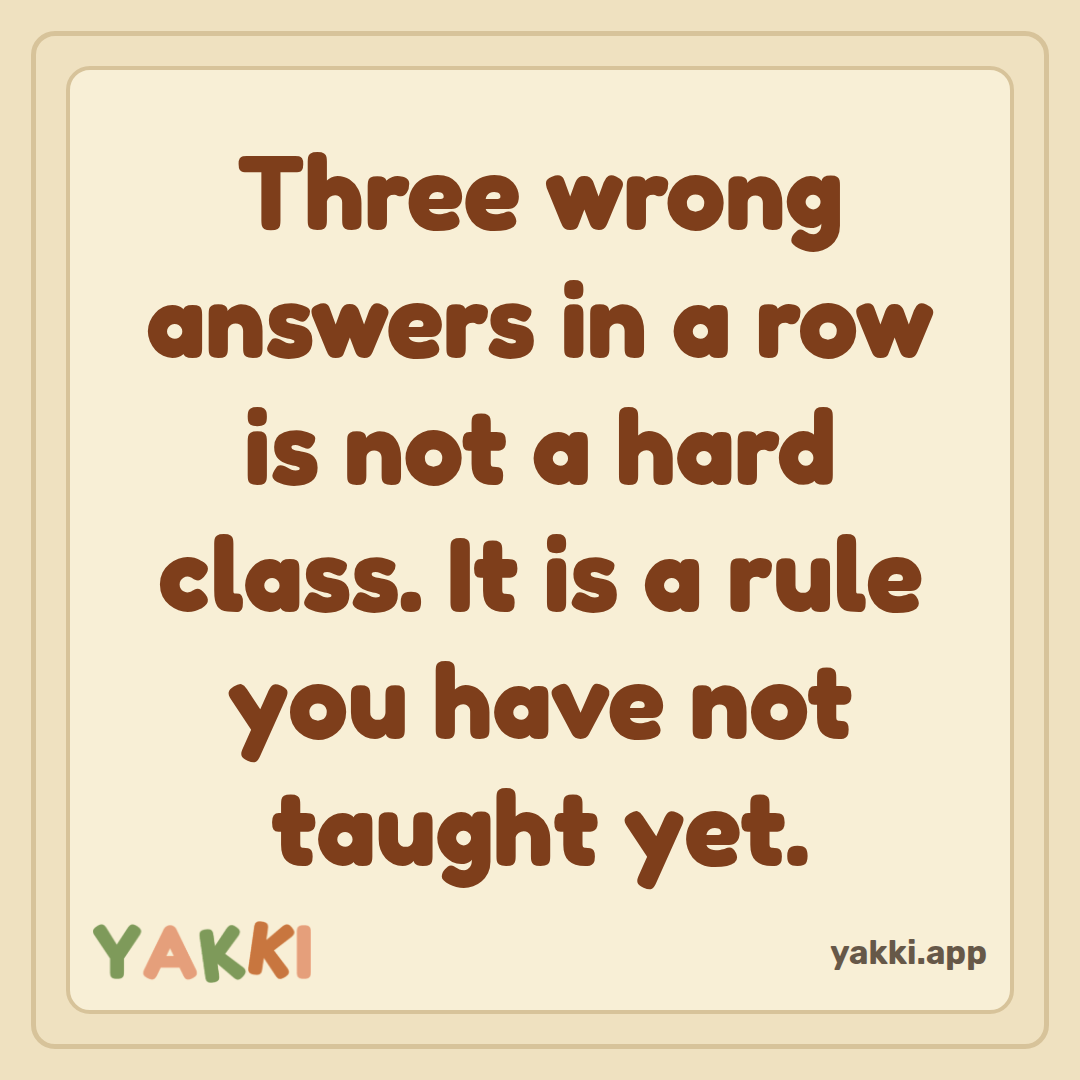
- Three wrong answers in a row: stop the game and reteach the rule.
- One student answering everything: move to pairs.
- Laughter but no English: your example sentences are too silly.
- Correct answers but no speed: the form is known and the habit is not. Keep the rule and raise the pace, or lengthen the sentences.
Stopping a game early costs nothing. Finishing a game that has stopped teaching costs the eight minutes you had left.
Making it last past Friday
One game is one encounter with the rule, however many repetitions it packs into ten minutes. What makes the rule stay is meeting it again, in a different shape, within the week.
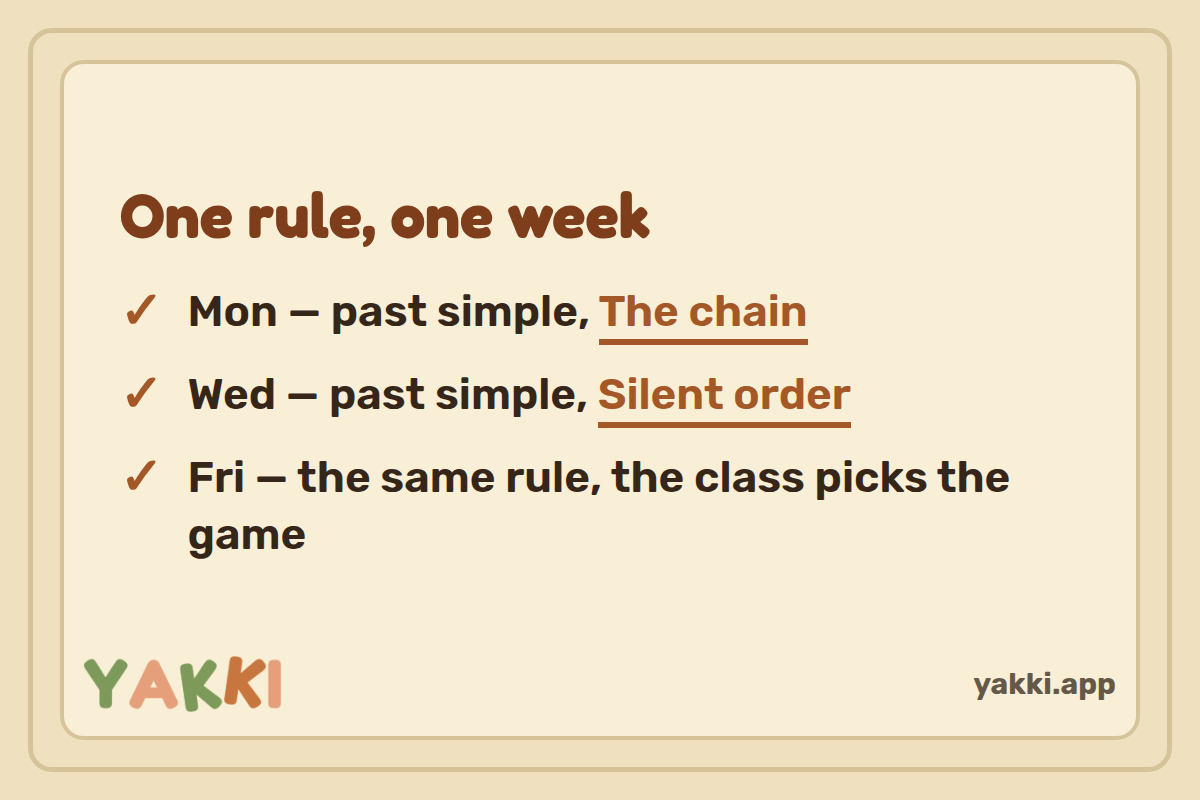
The shape matters more than the gap. The same rule in a game, in a clip and in a written exercise beats the same game three times.
Write the game and the rule on one card. Next week you need the card, not your memory, and ten cards will carry you through a term.
Three or four rules a term, drilled to the point of boredom, beat thirty rules met once. The games are there to make the repetition bearable.
Keep a list of the mistakes you heard. That list is your next lesson, and it is more honest than any coursebook.
More for teachers
Practise the rule, not the game
Every game above drills one rule. On yakki.app a rule page gives you the mistakes people actually make and practice right away — no sign-up. Thirty-one rules have an English clip today.