
For teachers
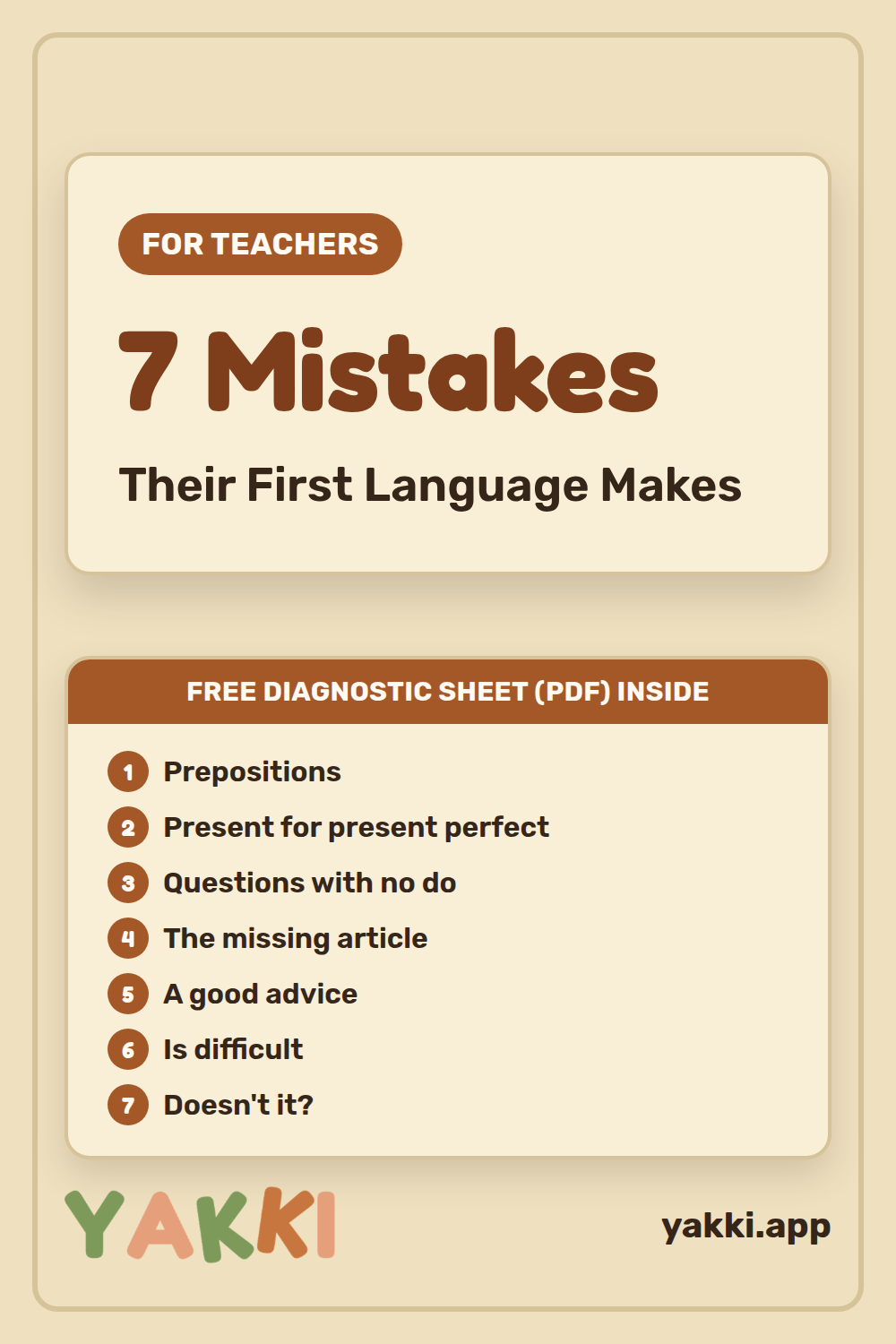
7 Mistakes Your Students Make Because of Their First Language
The same seven errors come back year after year, in every class, whatever the level. They are not carelessness. Each one is a rule from another language still running underneath the English.
A student who has studied English for six years still says He works on a factory. You correct it. Next week it is back.
That is the signature of transfer, not of inattention. The first language has a rule for this, and the rule is still firing.
This also explains why correcting it does not work. A correction reaches the part of the student that knows the rule. The error comes from the part that is not thinking about rules at all.
Below are the seven that travel furthest. For each one: the wrong sentence, the right one, and which first languages produce it.
Where the list comes from
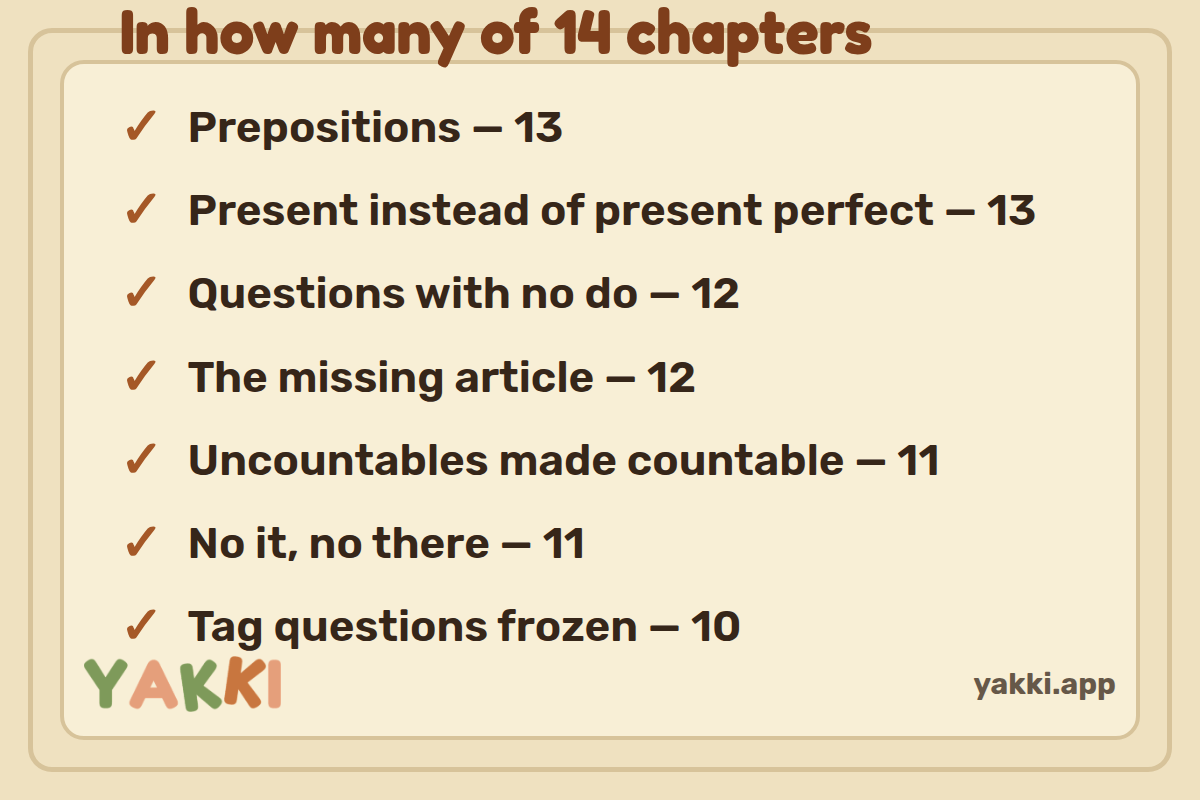
Swan and Smith's Learner English devotes a chapter to each first language and lists the errors its speakers make in English. We read fourteen of those chapters and counted how many give an example of each error type.
The seven below are the ones with the highest count. Nothing here is our guess: every line is an example the book prints.
The seven
1. Prepositions of time and place
The commonest error in the book, and the one with the least pattern to it. English picks its preposition per word, not per meaning.
- He works on a factory → at a factory
- arrive to the station → arrive at the station
Thirteen chapters of fourteen. Do not teach it as logic. Teach it as collocation, in phrases, with the noun attached.
2. Present where English needs present perfect
Since, for, already, yet are the trigger words. If the action started in the past and still holds, English switches tense and most languages do not.
- I still didn't read the book → I still haven't read the book
- I live here since 2019 → I have lived here since 2019
Thirteen chapters. This is the single most useful tense to drill against the clock.
3. Questions with no do
The learner keeps the word order of the statement and raises the voice instead.
- When you went there? → When did you go there?
- Why she is crying? → Why is she crying?
Twelve chapters. Spanish, Portuguese, Polish, Turkish, Russian and Arabic speakers all produce it, for the same reason: their languages ask with intonation.
4. The missing article
Some languages have no articles at all. Their speakers do not hear the gap.
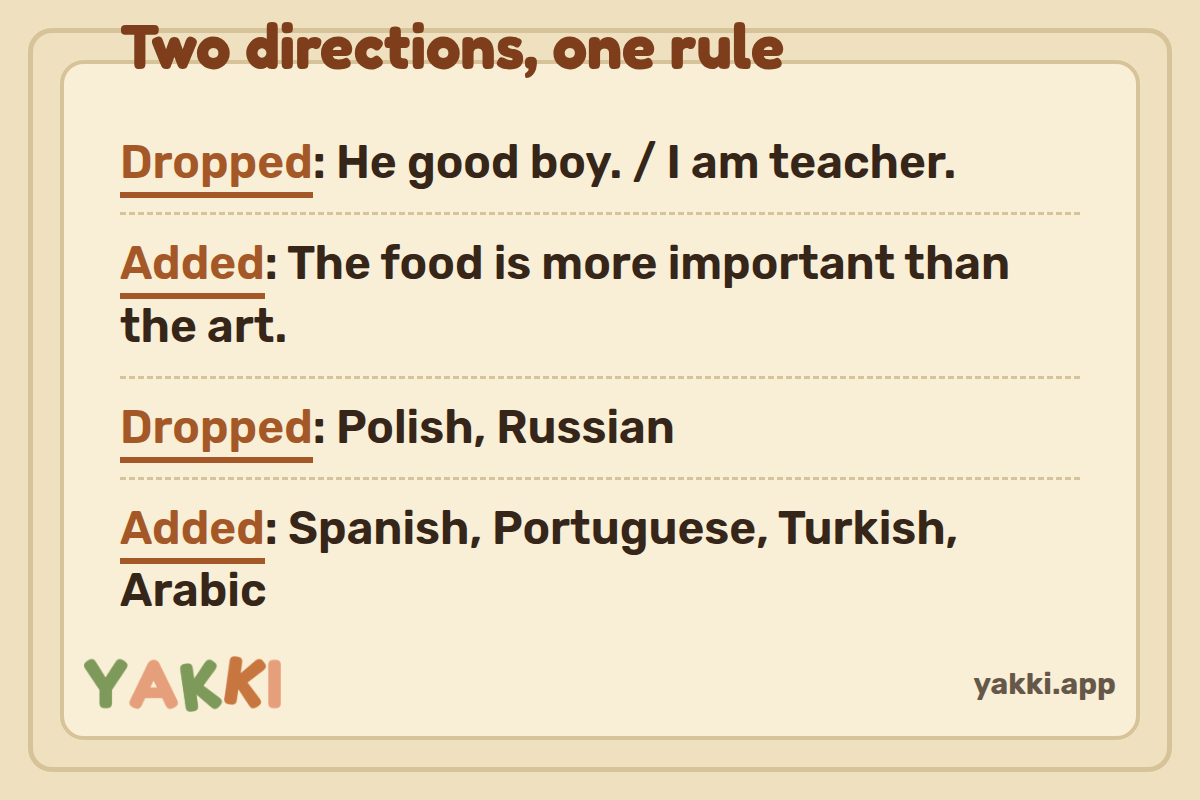
- He good boy → He is a good boy
- I am teacher → I am a teacher
Twelve chapters, and this one splits in two. Polish and Russian speakers drop articles; Spanish, Portuguese, Turkish and Arabic speakers add them where English wants none: the food is more important than the art.
5. Uncountables made countable
Advice, news, information, furniture, hair, money. In most other languages these take a plural and an article without trouble.
- I'll give you a good advice → some good advice
- I have many informations → a lot of information
Eleven chapters. Worth a wall list, because the set is small and closed.
6. No it, no there
English demands a subject even when there is nothing to put in it. Many languages do not, and the sentence comes out headless.
- Is difficult → It is difficult
- Is table in room? → Is there a table in the room?
Eleven chapters. Drill it as two fixed openings — it is and there is — rather than as grammar.
7. Tag questions frozen into one shape
The learner picks one tag and uses it for everything, because their language has exactly one: no?, isn't it?, eh?
- You like her, doesn't it? → don't you?
- She is coming, no? → isn't she?
Ten chapters. The tag is cheap to practise and expensive to ignore: it is the most audible of the seven.
Which of the seven belongs to your class
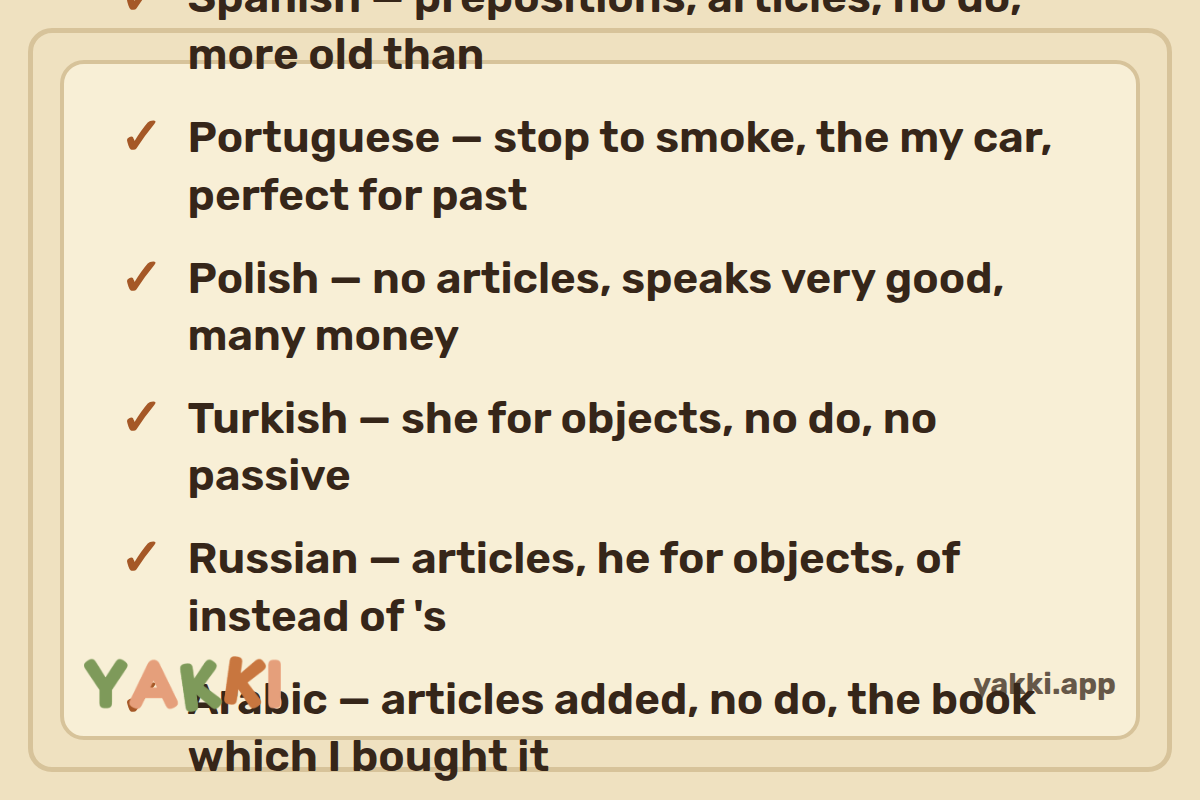
The counts above are across all fourteen languages. In your room only some of them apply, and knowing which saves half the correction.
Spanish. Prepositions, articles in both directions, questions with no do, more old than, the book of Rosa, and the inverted Arrived the firemen.
Portuguese. Stop to smoke for stop smoking, the my car, the perfect used where English wants a simple past, and double negation.
Polish. No articles at all, speaks very good, this is all what I want, many money, and can to do it.
Turkish. She used for objects, questions without do, the missing passive, reported speech with no backshift, and the my book.
Russian. Articles, he and she for objects, 's replaced by of, and a past simple where English wants a continuous.
Arabic. Articles added, no do-support, 's replaced by of, and the extra pronoun in the book which I bought it.
The question that sorts habit from gap
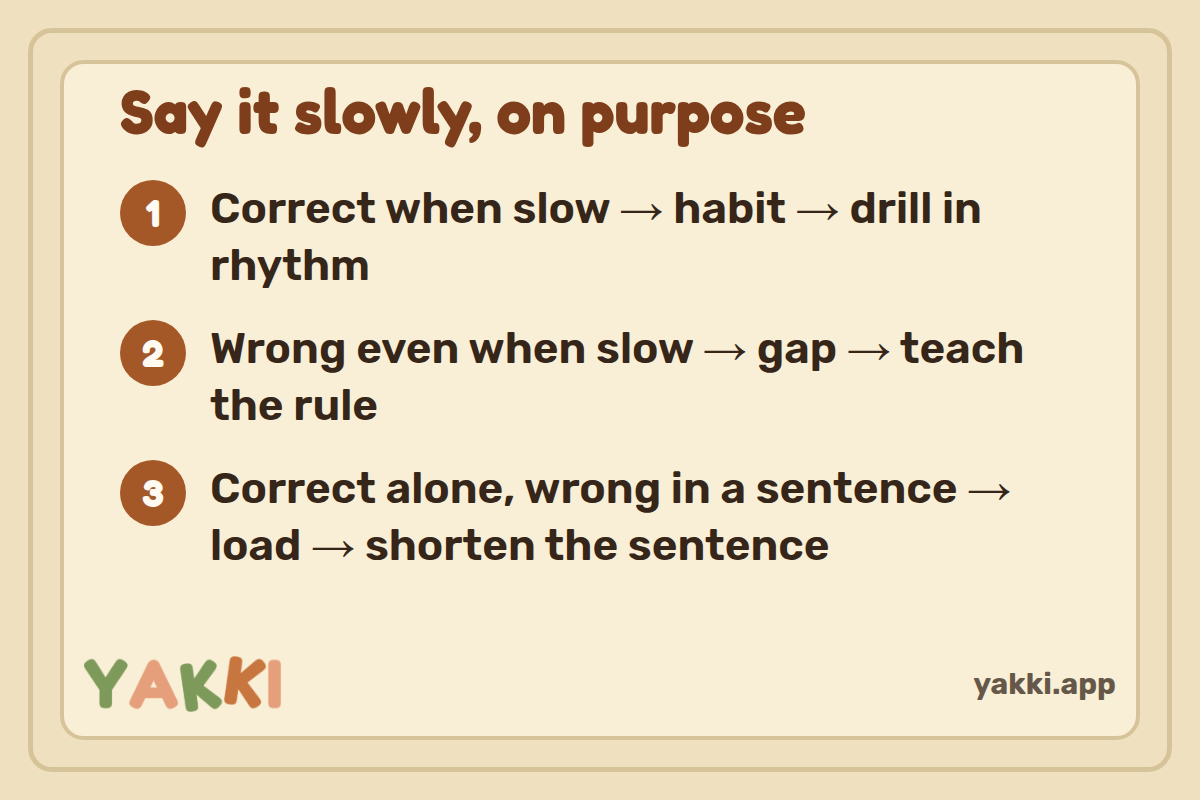
Not every repeated mistake is transfer. Before you build a lesson, ask the student to say the correct version deliberately.
- If they produce it correctly when slowed down, it is a habit. Drill it in rhythm, never in explanation.
- If they cannot produce it even slowly, the rule is missing. Teach it from the start, with one example and no exceptions.
- If they produce it correctly and then lose it inside a longer sentence, it is load. Shorten the sentences, not the grammar.
The seven-sentence diagnostic
One page. Seven sentences to dictate, the error each one hides, and a grid for marking which of your students break which. Print it, use it in the first ten minutes of a lesson.
No sign-up. Print as many as you need.
Three things this list is not
It is not a ranking of severity. A good advice is counted in eleven chapters and costs a listener nothing; a frozen tag is counted in ten and is heard immediately.
It is not a complete map of one language. Each chapter in the book holds thirty to sixty examples. We took the ones that repeat across languages.
And it is not evidence about your particular class. The counts say which errors travel; only the dictation on the sheet says which ones are in the room with you.
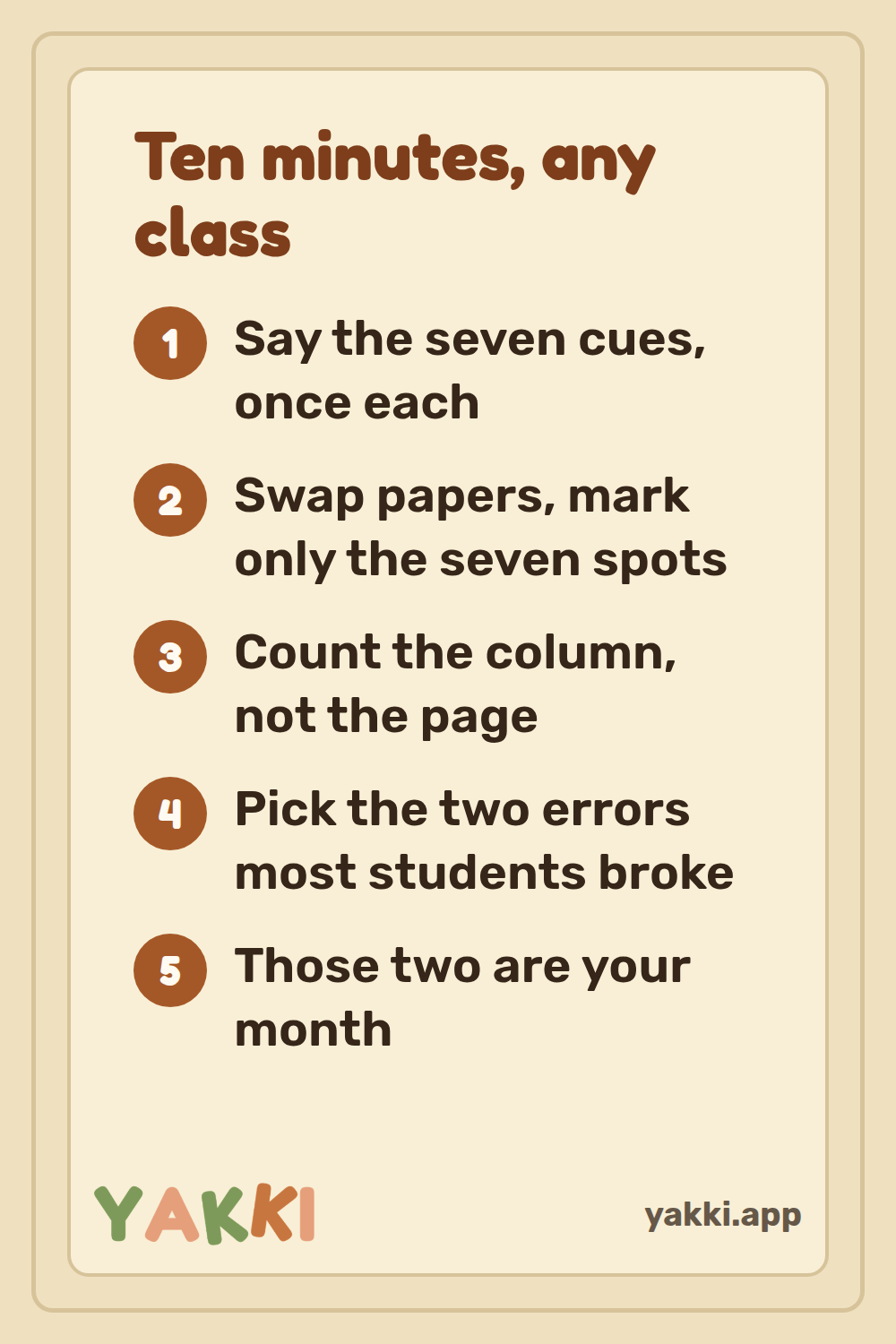
Seven errors, one page, ten minutes. After that you are correcting the two that matter instead of all of them.
More for teachers
Practice for the rule underneath
Each mistake above belongs to one rule. On yakki.app every rule has its own page: the mistakes learners actually make, and practice that starts in one click. Free, no sign-up.