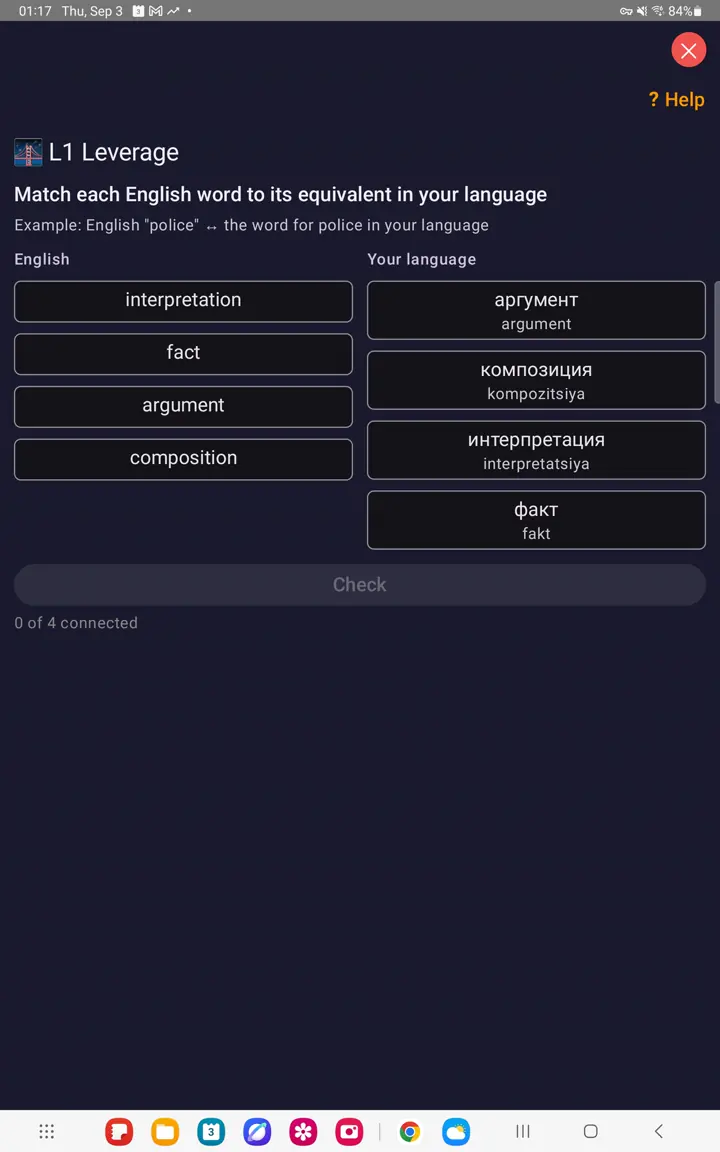
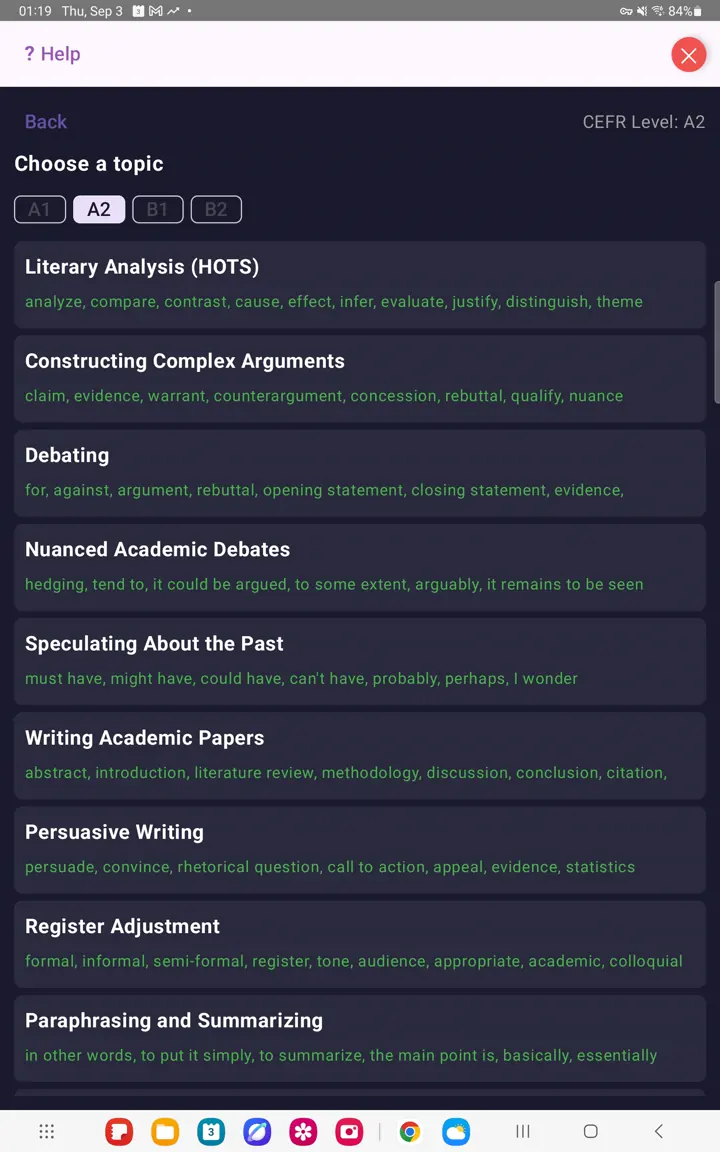
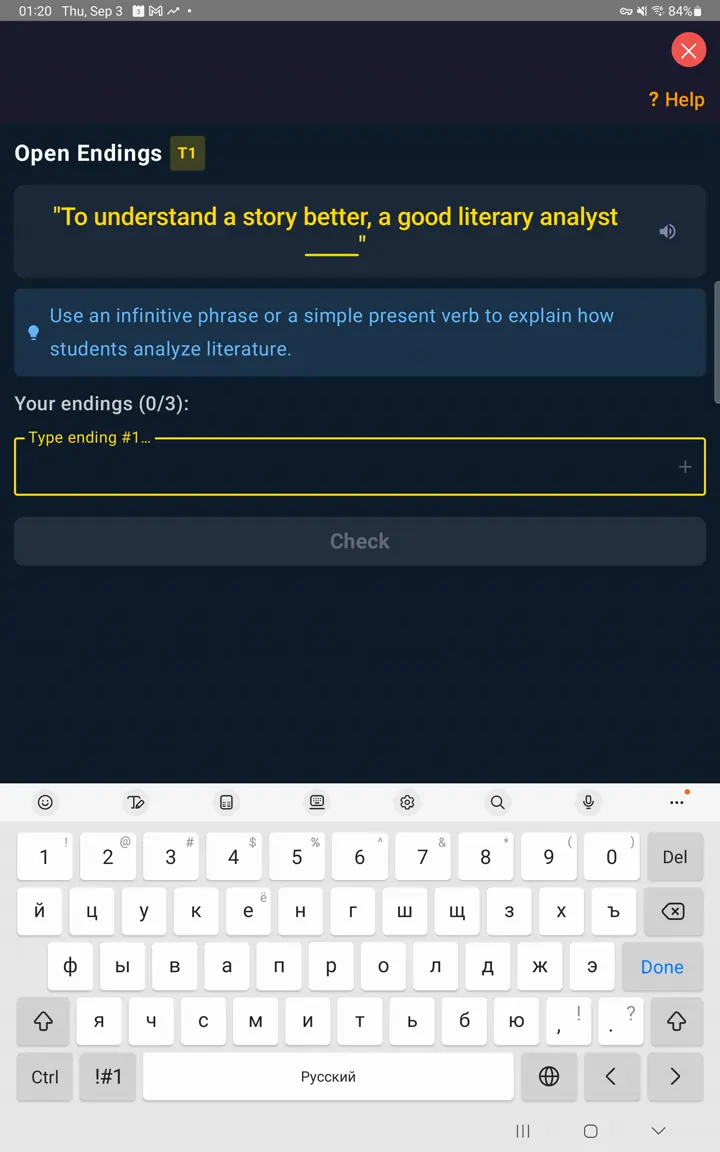
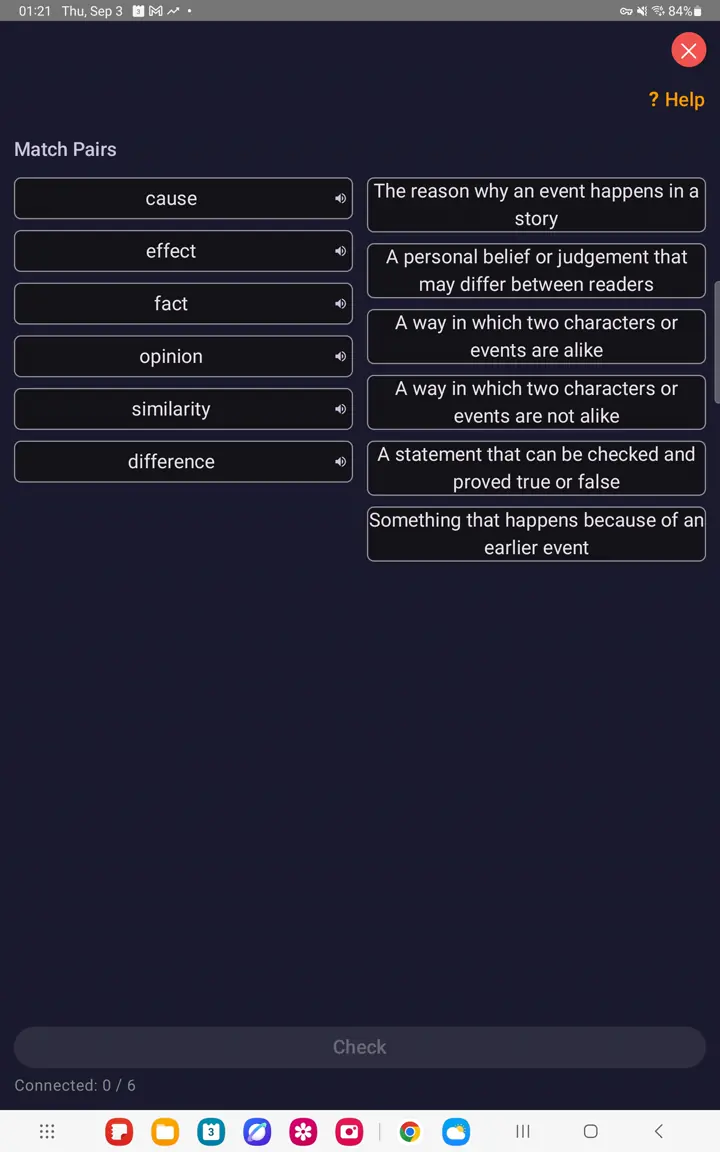
Labels next to each game: learning and check means the game can be assigned either way; learning only means it runs only as learning. Who opens a game, and why speech is not assessed: how the games work.
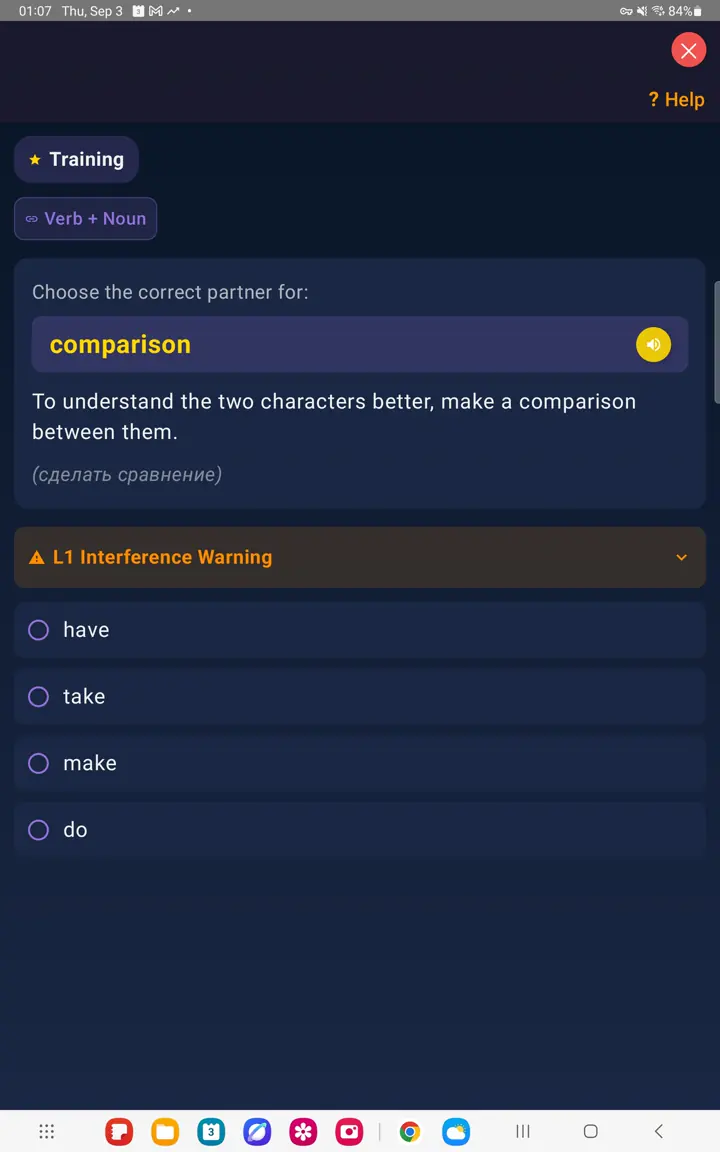
#9 Collocations learning and check
Make a decision, do homework — never the other way round. The learner picks the verb or adjective that naturally partners a given noun: make a decision, do homework, take a risk. Rounds target the combinations learners most often translate literally from their first language.
Draws on: Based on the Lexical Approach (Lewis, 1993) and Israeli research on L1 interference in collocations (Laufer, University of Haifa).
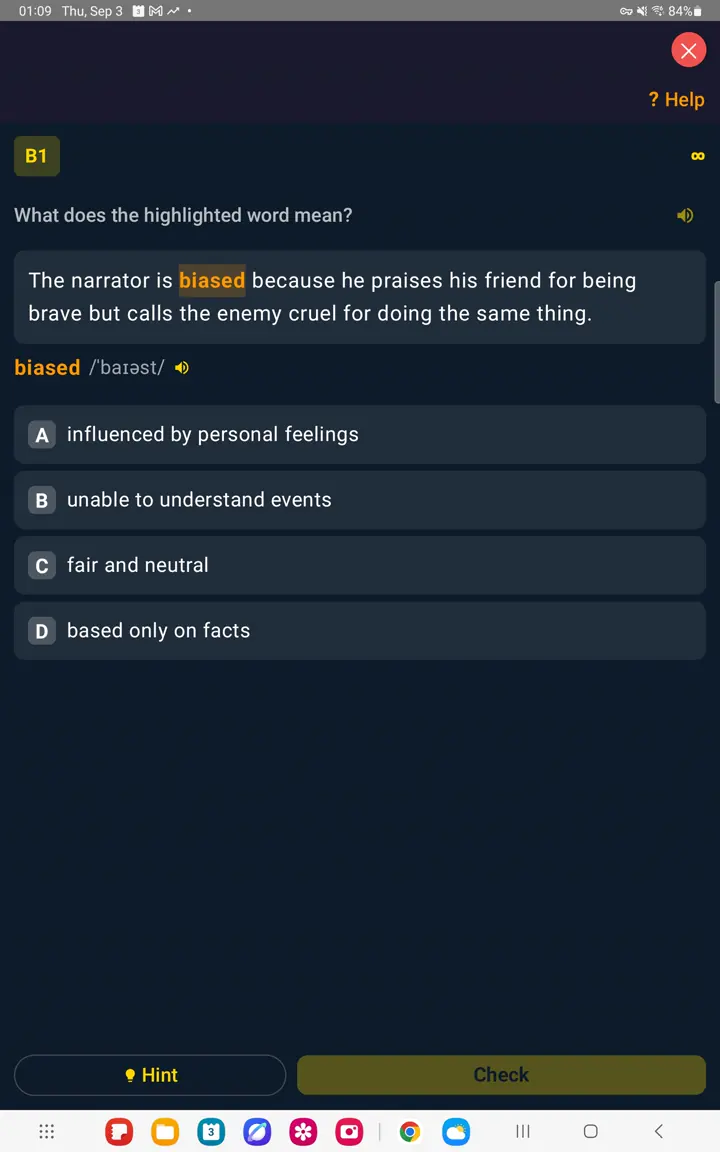
#16 Context Clues learning and check
Meet an unknown word — and outsmart it. A text contains a highlighted unfamiliar word; the learner infers its meaning purely from context and picks from four options. The single most useful skill for independent reading.
Draws on: Trains incidental vocabulary acquisition through inference (Hulstijn, 2001).
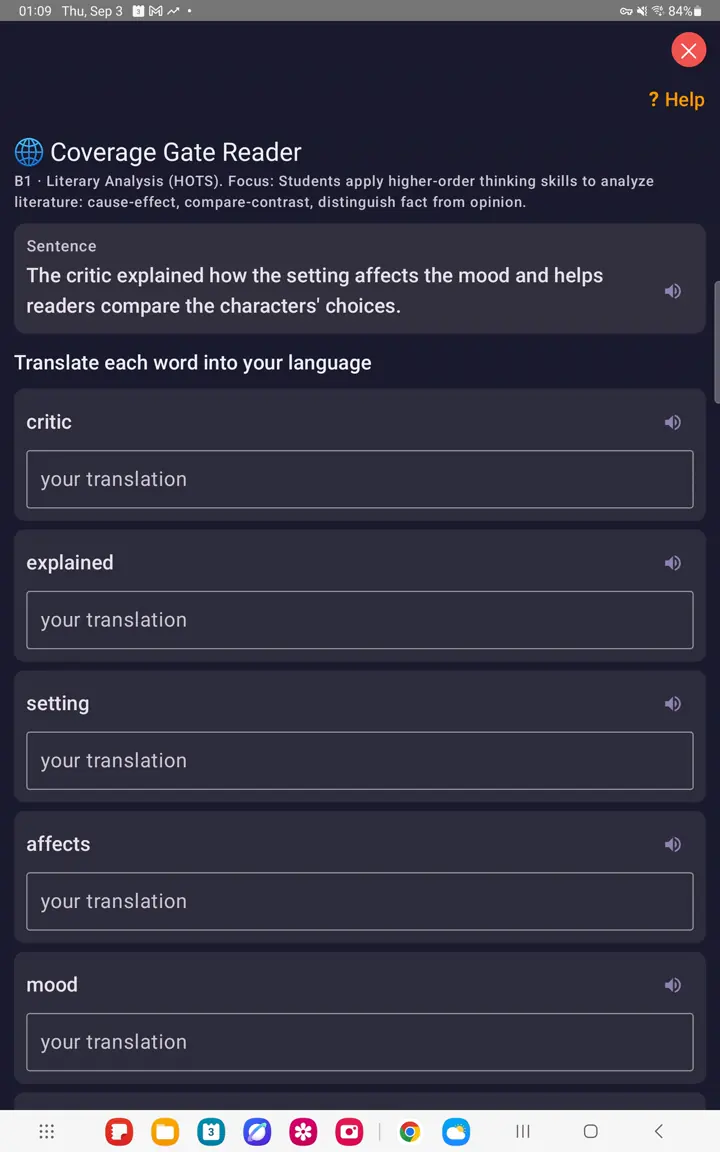
#17 Reading Gate learning and check
Learn the blocking words first — then the text opens. Before reading, the system finds the few unknown words that would block comprehension and teaches them first. Only then does the gate open to the full text — which the learner can now actually understand.
Draws on: Implements the 95% lexical coverage threshold for reading comprehension (Laufer, 1989, University of Haifa).
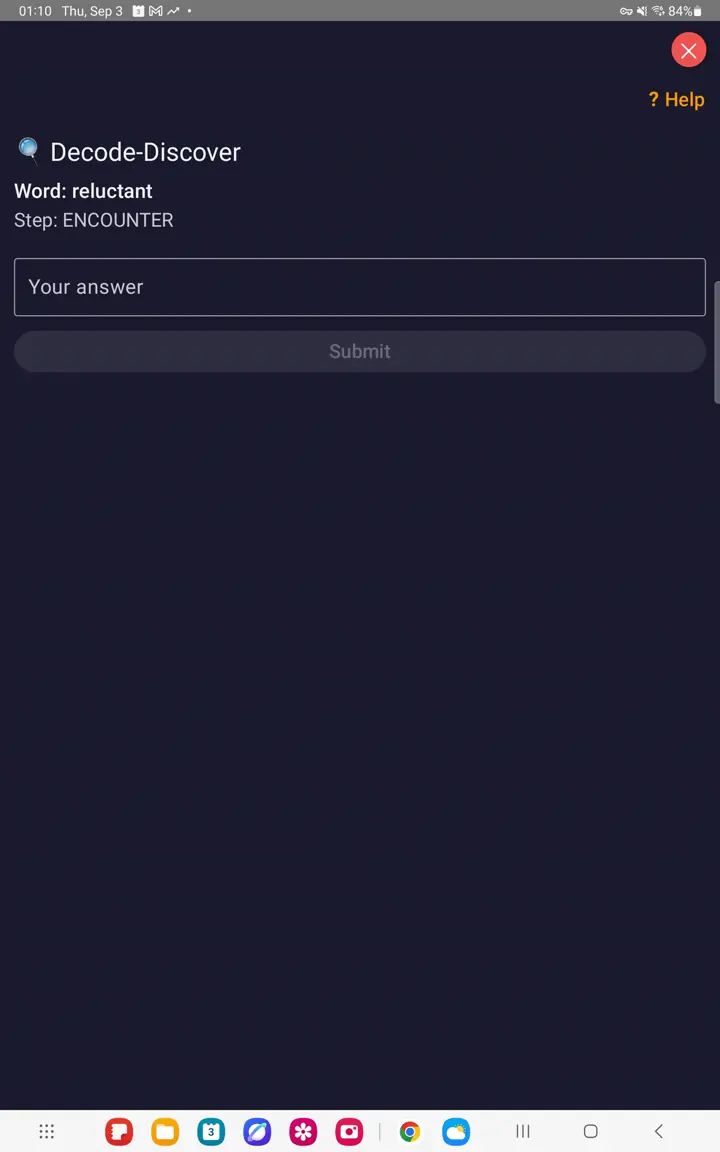
#19 Decode and Discover learning and check
Sound it out, unlock the meaning. The learner meets an unknown written word, decodes it aloud using phonics rules, then discovers its meaning — forging the sound-spelling-meaning bond in one self-driven act. Every successful decode is a word the learner taught themselves.
Draws on: Direct implementation of the Self-Teaching Hypothesis (Share, 1995, University of Haifa).
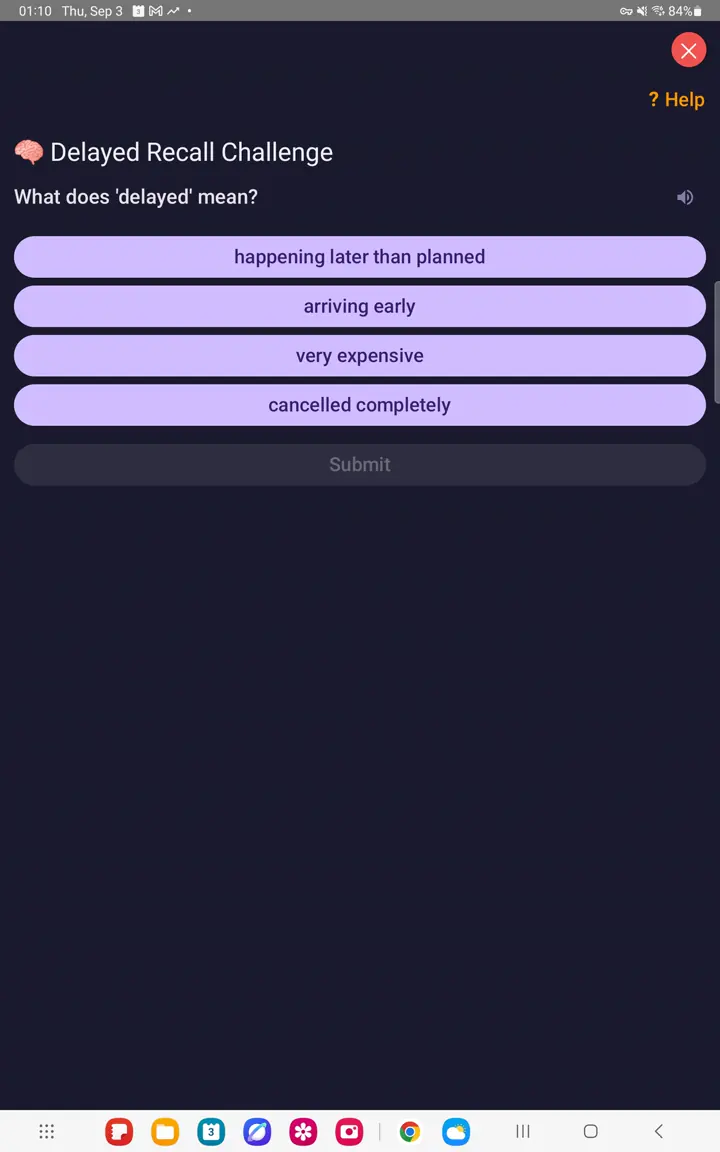
#20 Do You Remember? learning and check
The surprise test that makes words permanent. The app quietly tracks learned words and springs surprise recall checks at growing intervals — a day, a week, a month. Each successful retrieval at the right moment locks the word deeper into long-term memory.
Draws on: Based on retention research showing delayed, unannounced testing predicts durable learning (Laufer, 2005, University of Haifa).
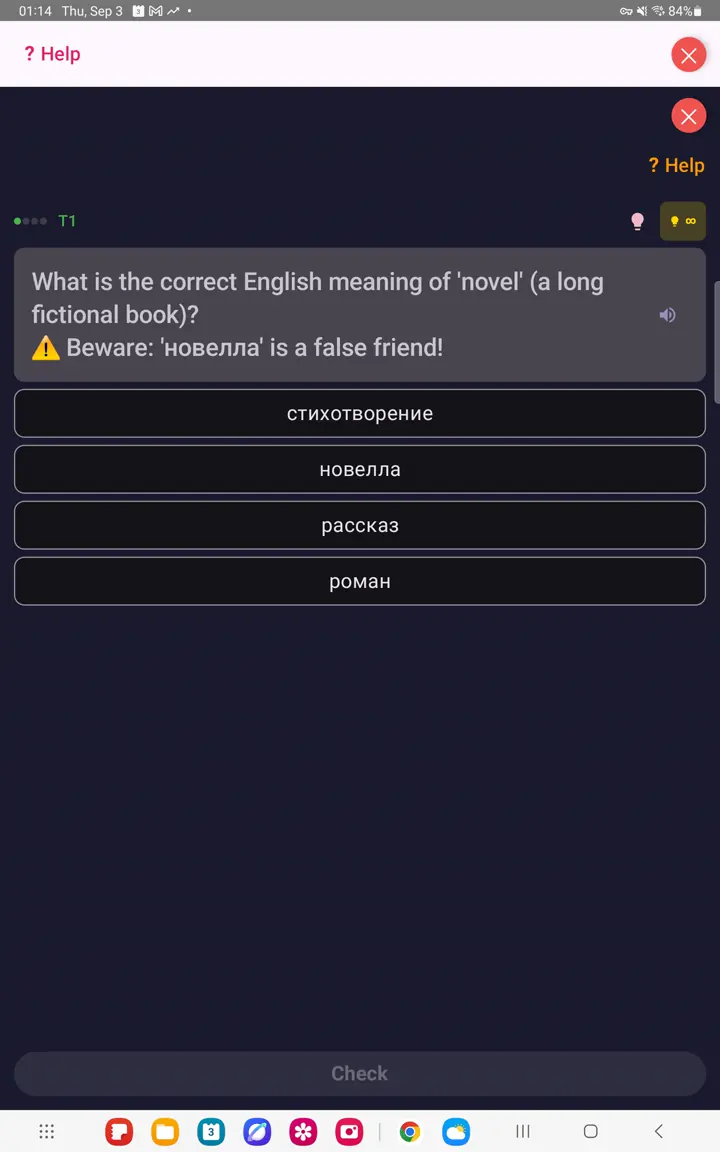
#33 False Friends learning and check
Magazine is not a shop, and actual is not the Russian aktualny. The learner decides whether a familiar-looking word really means what it seems to. Each round exposes a trap word that looks like one in the learner's first language but means something else entirely.
Draws on: Based on cross-linguistic influence research (Jarvis & Pavlenko, 2008), tuned to Hebrew and Russian false cognates.
#36 Flashcard learning and check
Classic cards, supercharged by self-assessment. The learner sees a word, recalls its meaning, flips the card to check, and honestly rates themselves: knew it or not. The app uses these ratings to bring difficult words back at the right moment.
Draws on: Built on spaced repetition and active recall research (Ebbinghaus; Pimsleur, 1967; Nation, 2001).
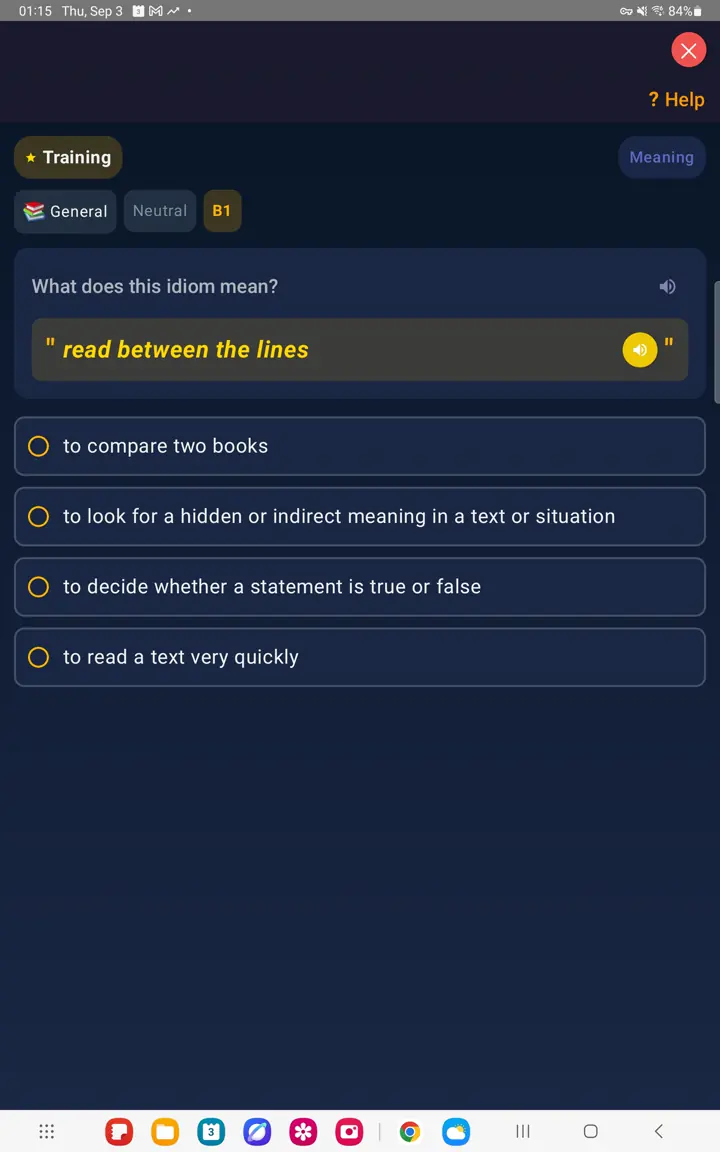
#39 Idiom Match learning and check
Crack the code of English idioms. Idioms on the left, meanings on the right — connect them correctly. The learner discovers that idioms cannot be translated word by word and starts recognising them in real texts.
Draws on: Develops figurative competence (Gibbs, 1994), a key marker of advanced proficiency.
#45 Your Language Helps learning and check
Your first language is an asset, not an obstacle. Tasks deliberately use what the learner already knows: cognates, shared structures and transfer patterns between their first language and English — while flagging false friends. The native language becomes a bridge instead of a source of mistakes.
Draws on: Based on multilingual literacy research showing L1 knowledge accelerates L2 acquisition (Schwartz, 2011, Oranim College).
#51 Match Image learning and check
See it, name it, connect it. Pictures on one side, words and phrases on the other — connect each image to its word. Visual anchoring makes new vocabulary stick for beginners.
Draws on: Direct application of dual coding theory: image plus word forms two memory traces instead of one (Paivio, 1971).
#52 Memory learning and check
Flip cards, find pairs, remember words. Face-down cards hide words and their translations. Flip two at a time — a match disappears, a miss flips back. The playful format trains visual and working memory while quietly recycling vocabulary.
Draws on: Combines dual coding (Paivio, 1986) with working-memory training in a low-stakes game format.
#58 Open Endings learning and check
Finish the sentence your way Finish the sentence in your own words. A simple ending and a complex one are both accepted, and the difference shows in the report.
#60 Match Pairs learning and check
Connect words to meanings with a single line. Two columns: words on the left, translations or definitions on the right. The learner draws connections between matching items — word and translation, idiom and meaning. The AI analyses error patterns to spot confusable pairs.
Draws on: Grounded in dual coding theory and retrieval practice for associative memory (Paivio, 1986).
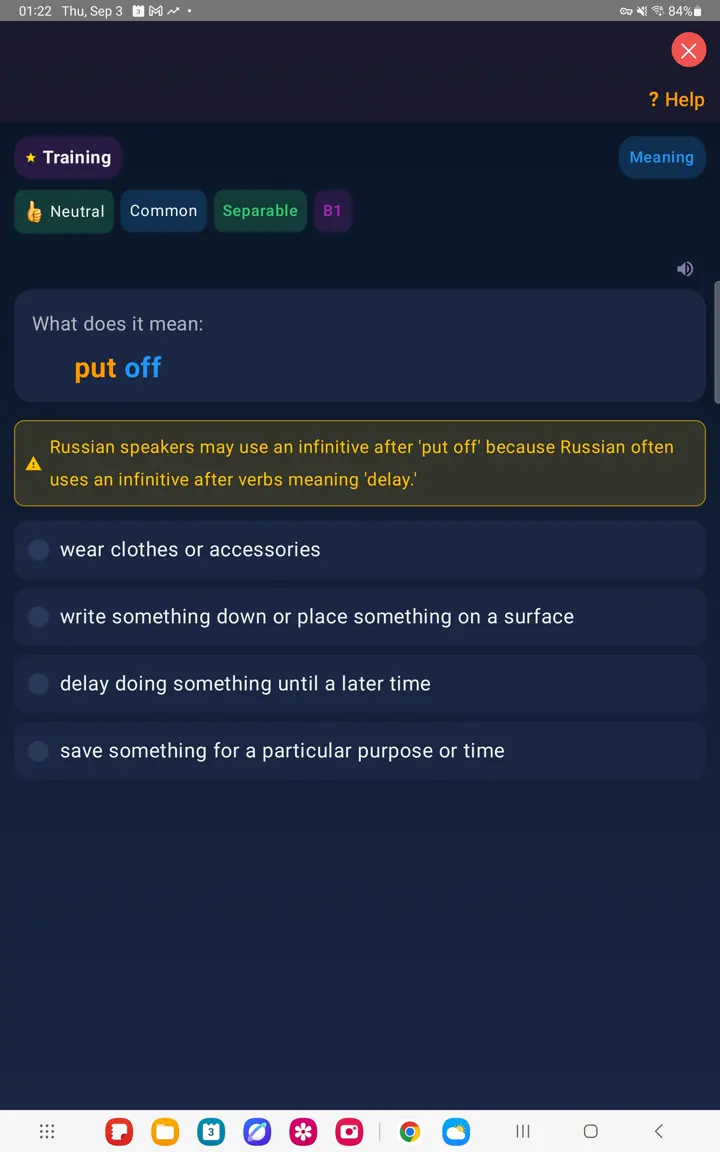
#63 Phrasal Verbs learning and check
Stop avoiding give up, look after and put off. Several practice modes in one game train the verbs learners fear most: phrasal verbs. The learner matches, completes and chooses correct particles in context until give up and put off feel natural.
Draws on: Targets the documented avoidance of phrasal verbs by Hebrew speakers (Dagut & Laufer, 1985).
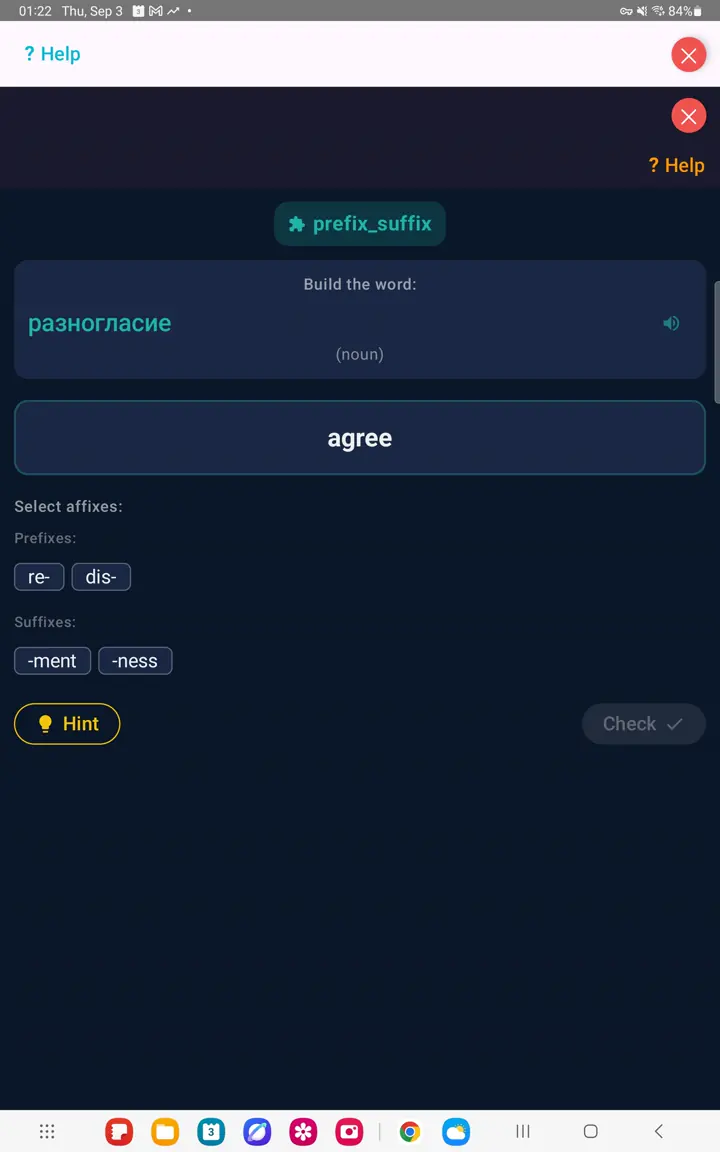
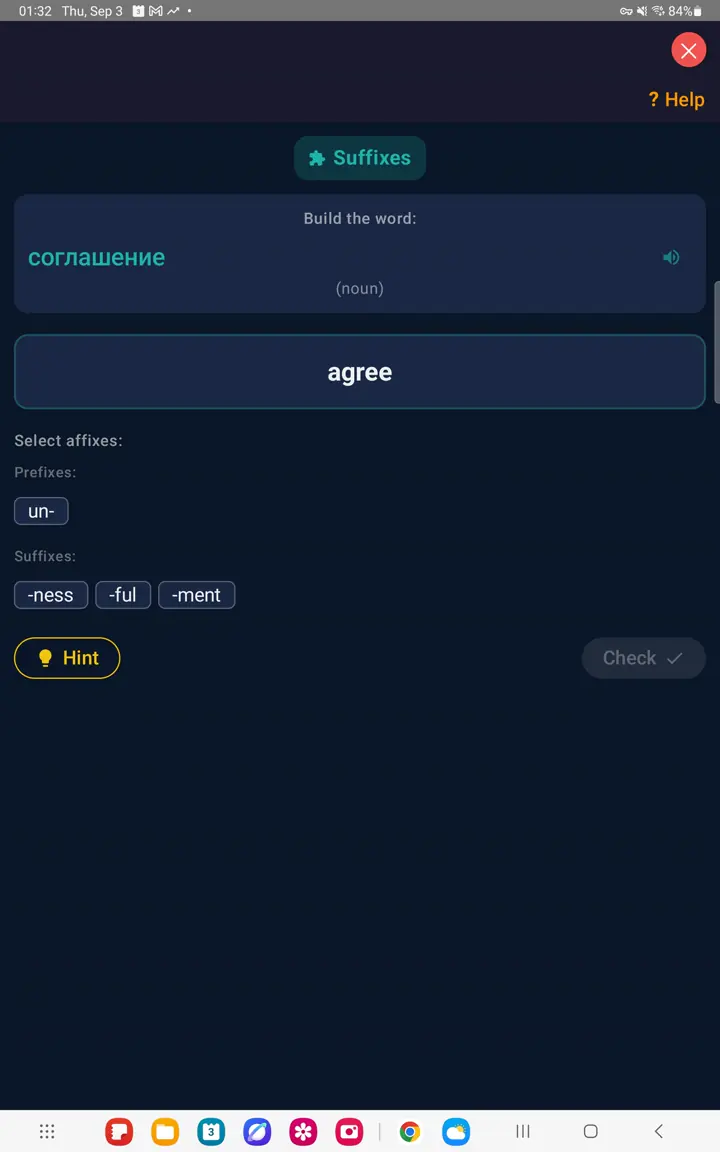
#66 Prefix Suffix learning and check
Un-, dis-, -ness, -ment: small parts, big power. A word appears with a missing prefix or suffix; the learner chooses the right affix. Affix mastery multiplies vocabulary without memorising new words.
Draws on: Builds derivational morphological awareness (Carlisle, 2000) — especially valuable for speakers of root-pattern languages like Hebrew.
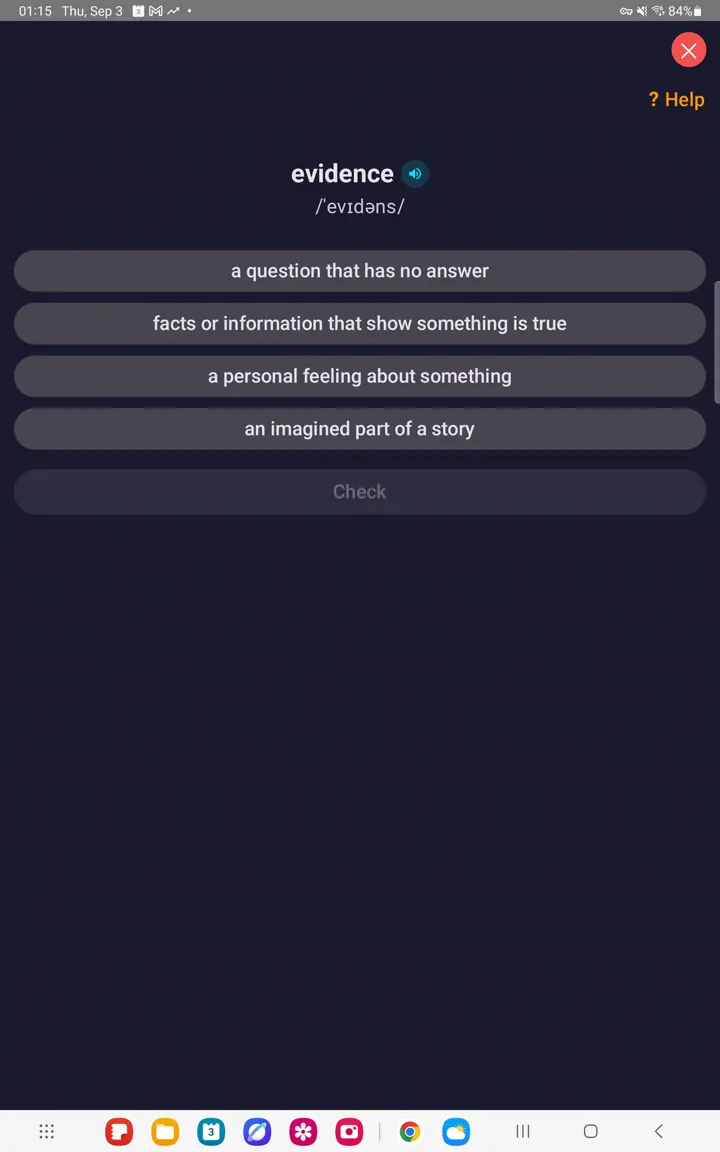
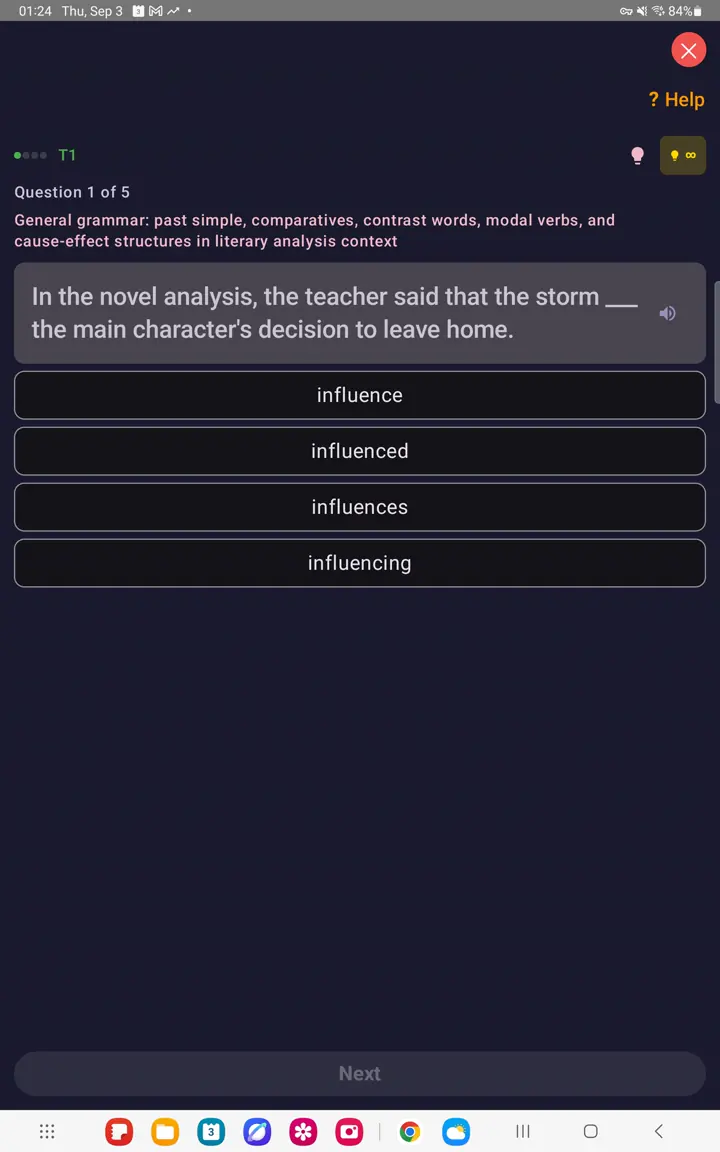
#73 Multiple Choice learning and check
Four options, one right answer — and a clear explanation why. A classic multiple-choice quiz with instant feedback. When the learner slips, the AI explains why each option works or doesn't. Covers vocabulary, grammar and comprehension at any level.
Draws on: Leverages the testing effect: retrieval through quizzing strengthens memory more than re-reading (Roediger & Karpicke, 2006).
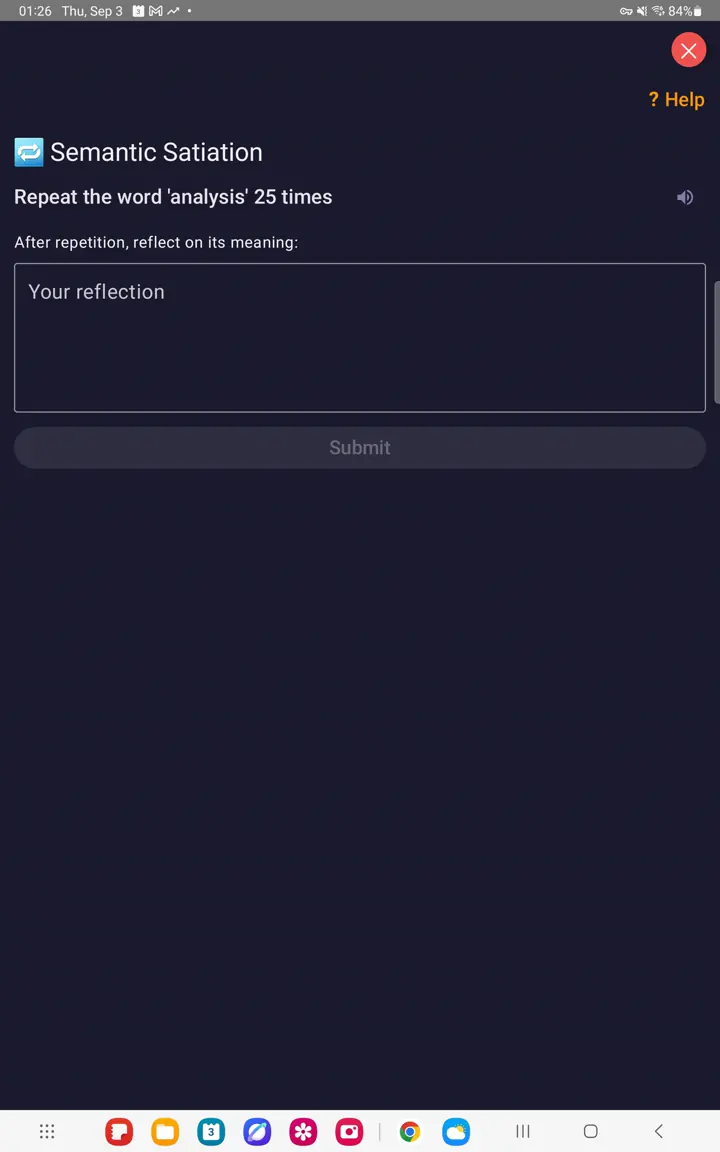
#80 Word Overload learning and check
What happens when a word stops meaning anything? A playful experiment with meaning: the learner works with a word through rapid repetition and varied contexts, noticing how meaning fades and re-anchoring it through fresh examples. An unusual route to deep, flexible word knowledge.
Draws on: Inspired by semantic satiation research (Jakobovits; Tian) applied to deep semantic processing of vocabulary.
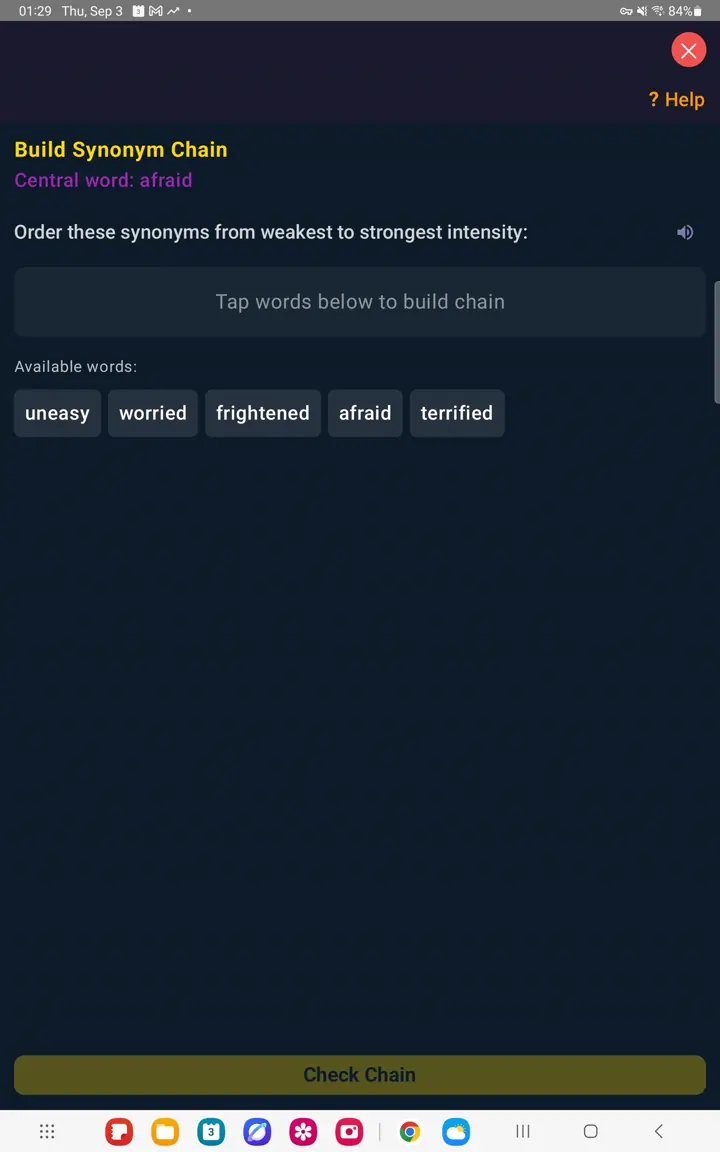
#91 Synonym Chains learning and check
From angry to furious to livid — order the heat. The learner arranges a chain of near-synonyms from weakest to strongest (angry → furious → livid). Sensing the gradation between synonyms is what separates a rich vocabulary from a merely big one.
Draws on: Builds lexical networks via lexical priming theory (Hoey, 2005).
#92 Synonym Ladder learning and check
Climb step by step toward stronger words. Each rung of the ladder holds a word; the learner picks the next word that is just a little more intense than the previous one. A step-by-step way to master shades of meaning.
Draws on: Grounded in lexical semantics and semantic gradience research (Cruse, 1986; Aitchison, 2012).
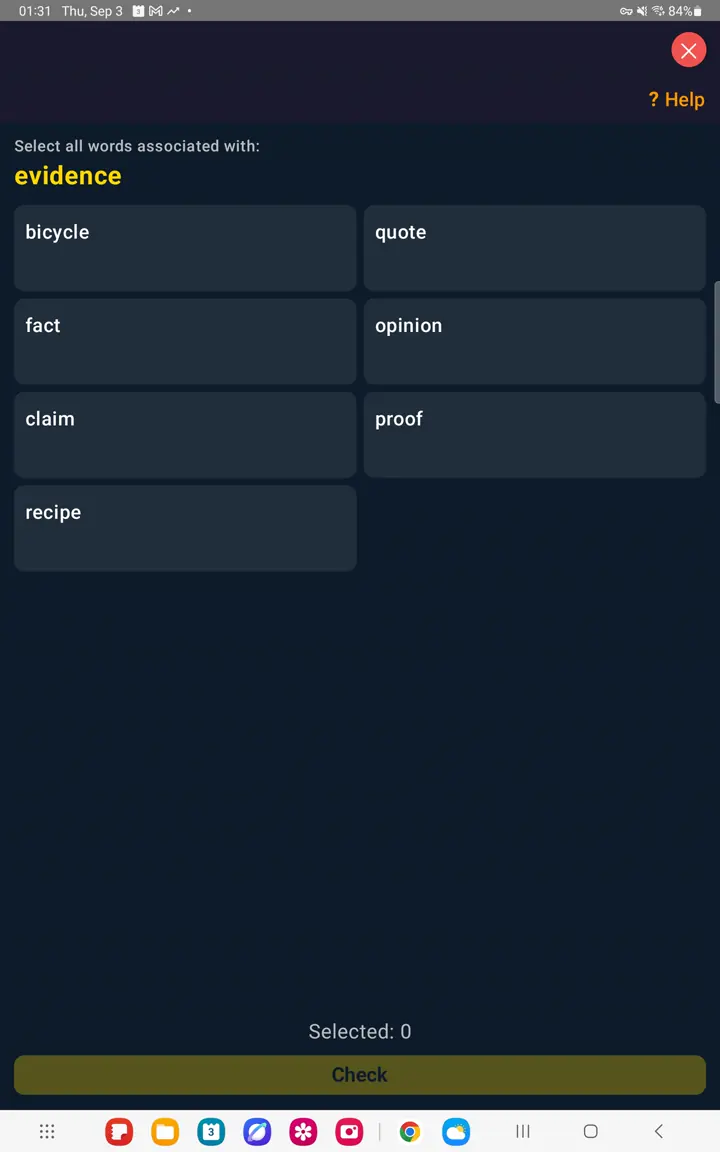
#100 Word Associations learning and check
Which words live next to ocean in an English mind? A central word is surrounded by eight candidates; the learner selects all that genuinely associate with it in English. Builds the dense web of connections that lets words come to mind quickly.
Draws on: Based on spreading activation models of the mental lexicon (Collins & Loftus, 1975).
#103 Word Formation learning and check
From beauty to beautiful to beautifully. A root word is given (beauty) and a sentence has a gap: the learner derives the form the sentence needs — beautiful, beautifully, beautify. One root unlocks a whole word family.
Draws on: Develops morphological awareness, a strong predictor of vocabulary growth (Kuo & Anderson, 2006).
#104 Words You Need learning and check
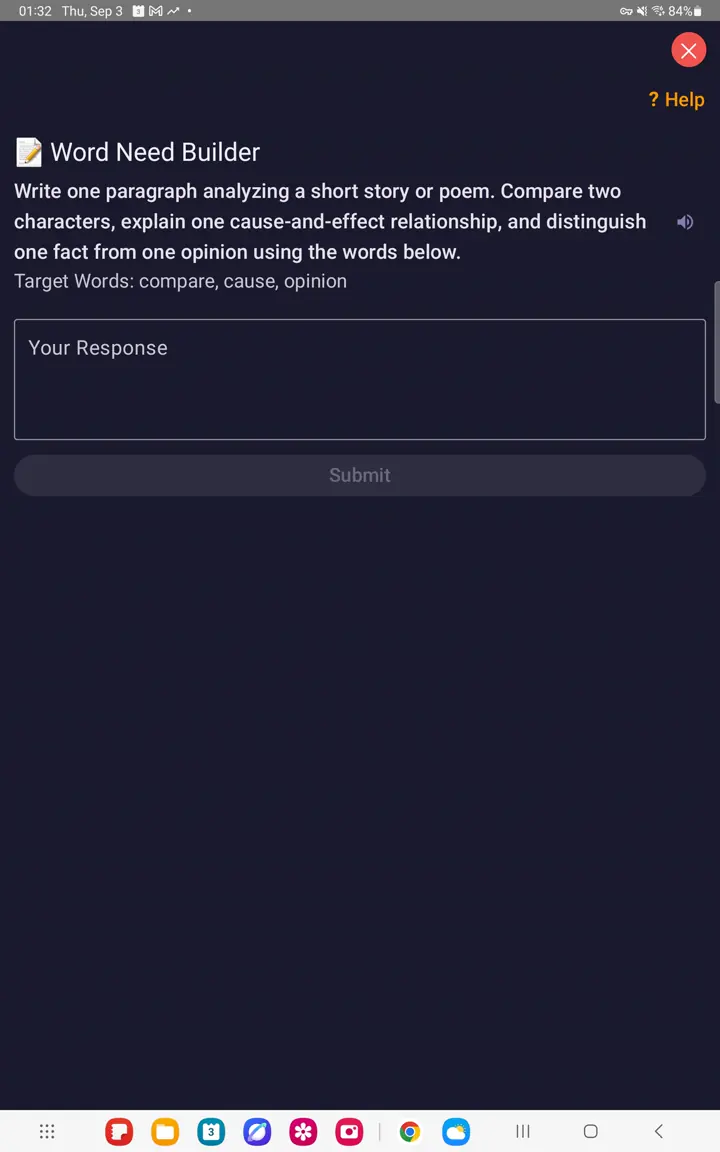
Need the word? Then you'll remember it. The learner must use specific target words in their own production — completing sentences, writing definitions, building short paragraphs — without the words being handed to them. Creating a genuine need for a word moves it from passive to active vocabulary.
Draws on: Applies the Need component of the Involvement Load Hypothesis (Laufer & Hulstijn, 2001).
#105 Word Search learning and check
Hunt hidden words in a letter grid. A letter grid hides target words horizontally, vertically and diagonally. The learner swipes to highlight each word from the list. Scanning letter patterns strengthens spelling and word-form recognition.
Draws on: Supports incidental learning and orthographic mapping — especially valuable for learners switching from right-to-left scripts (Hulstijn, 2001).