Labels next to each game: learning and check means the game can be assigned either way; learning only means it runs only as learning. Who opens a game, and why speech is not assessed: how the games work.
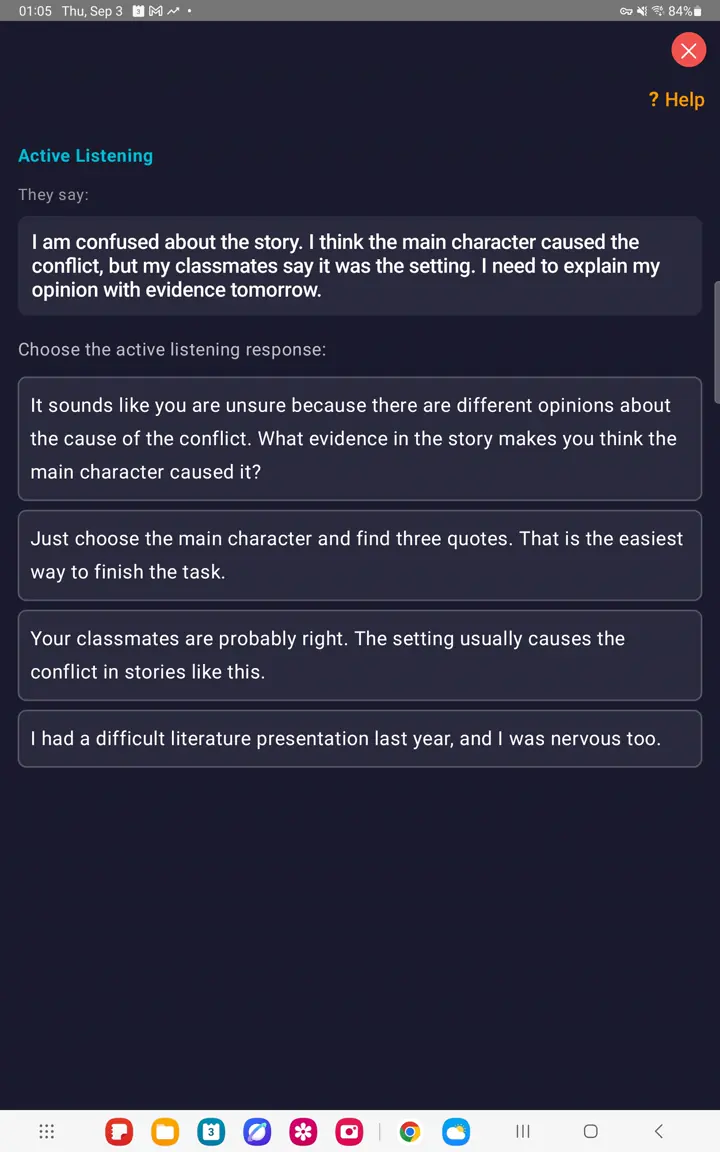
#2 Active Listening learning and check
Show them you truly heard. Students practice the verbal moves of active listening in English: reflecting, clarifying, summarizing what the speaker said. The listener's side of a conversation finally gets its own training.
Draws on: Metacognitive, strategy-based listening instruction improves both comprehension and interaction (Vandergrift & Goh 2012).
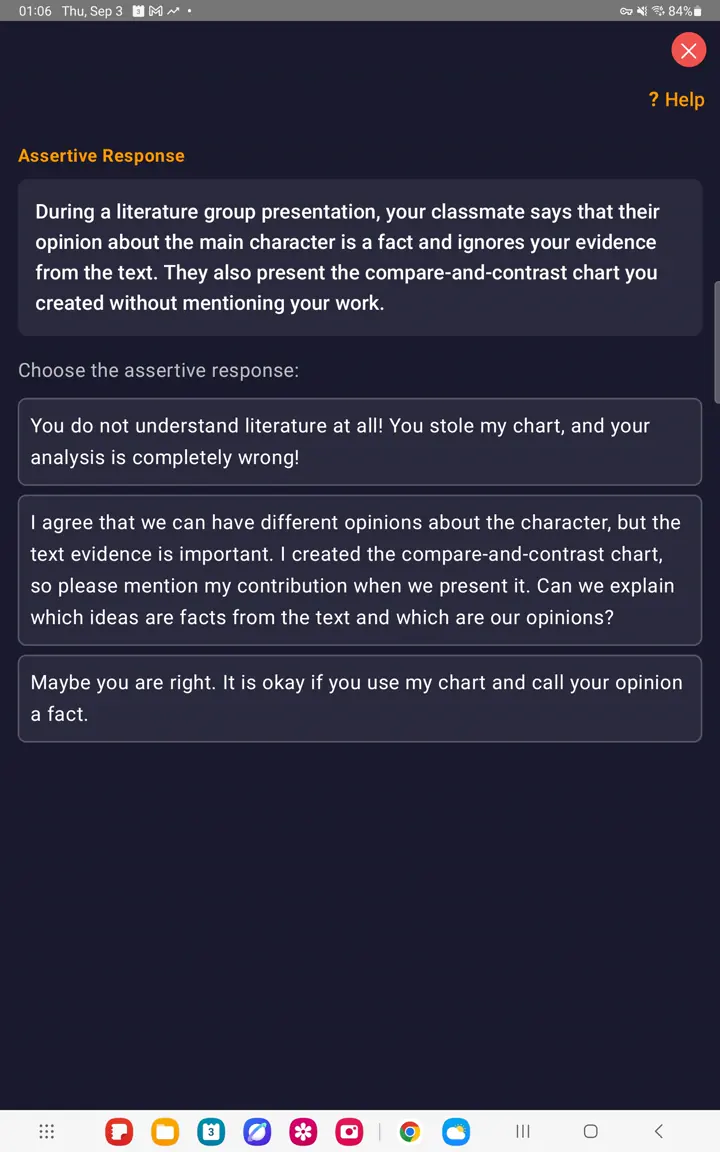
#5 Assertive Response learning and check
Not a doormat, not a bulldozer — assertive. Given a tricky situation, students choose or build the assertive English response between the passive and aggressive extremes. Standing your ground politely is a language skill — and it's trainable.
Draws on: Assertiveness balances self-respect with face concerns of the other, formalized in politeness theory (Brown & Levinson 1987).
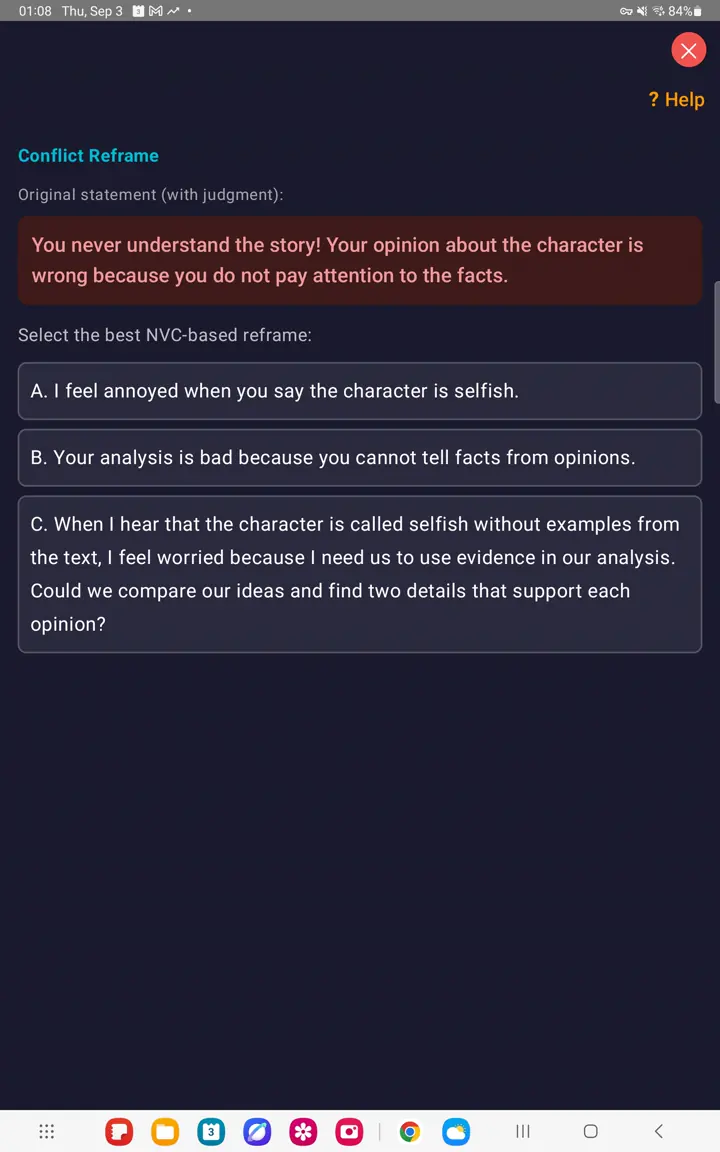
#12 Conflict Reframe learning and check
Same situation, calmer words. Students take heated conflict lines and reframe them into constructive English: from blame to observation, from attack to request. The skill of cooling down a conversation gets concrete practice.
Draws on: Cognitive reappraisal — reinterpreting a situation — is one of the most effective emotion regulation strategies (Gross 2002).
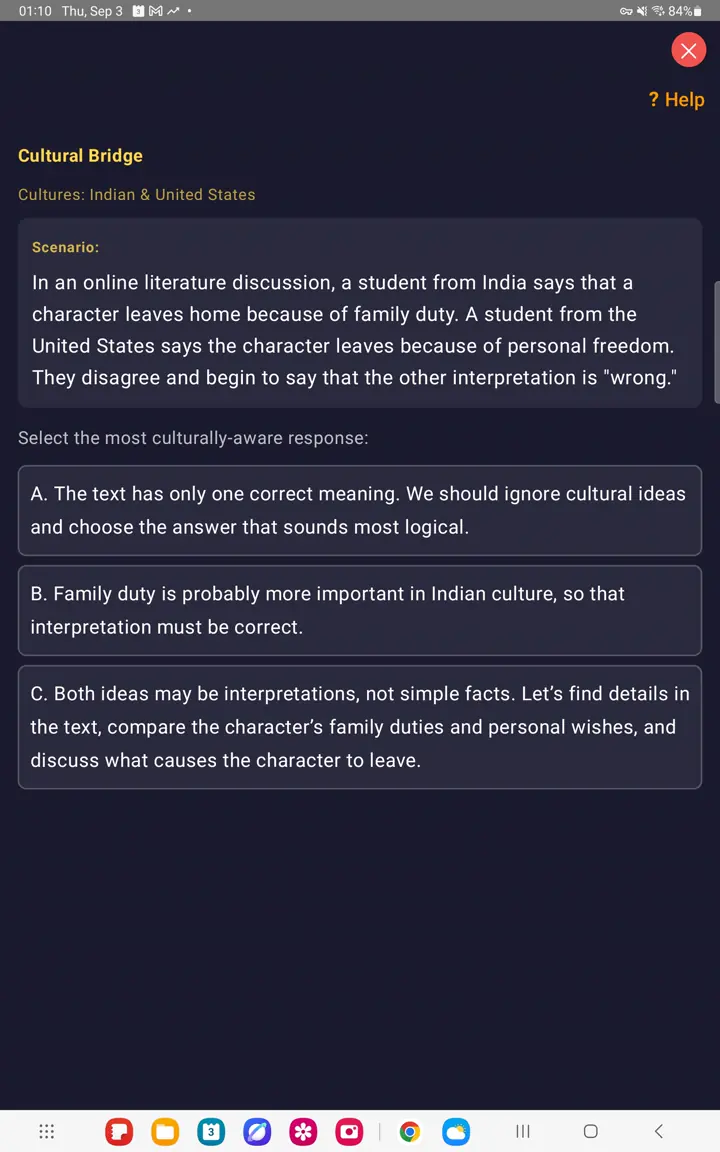
#18 Cultural Bridge learning and check
Decode the moment when cultures collide. Students analyze short cross-cultural misunderstandings — a joke that fell flat, an offer refused "wrongly" — and identify what each side assumed. Cultural empathy becomes a skill, not luck.
Draws on: Intercultural communicative competence — interpreting and relating across cultures — is a defined, teachable model (Byram 1997).
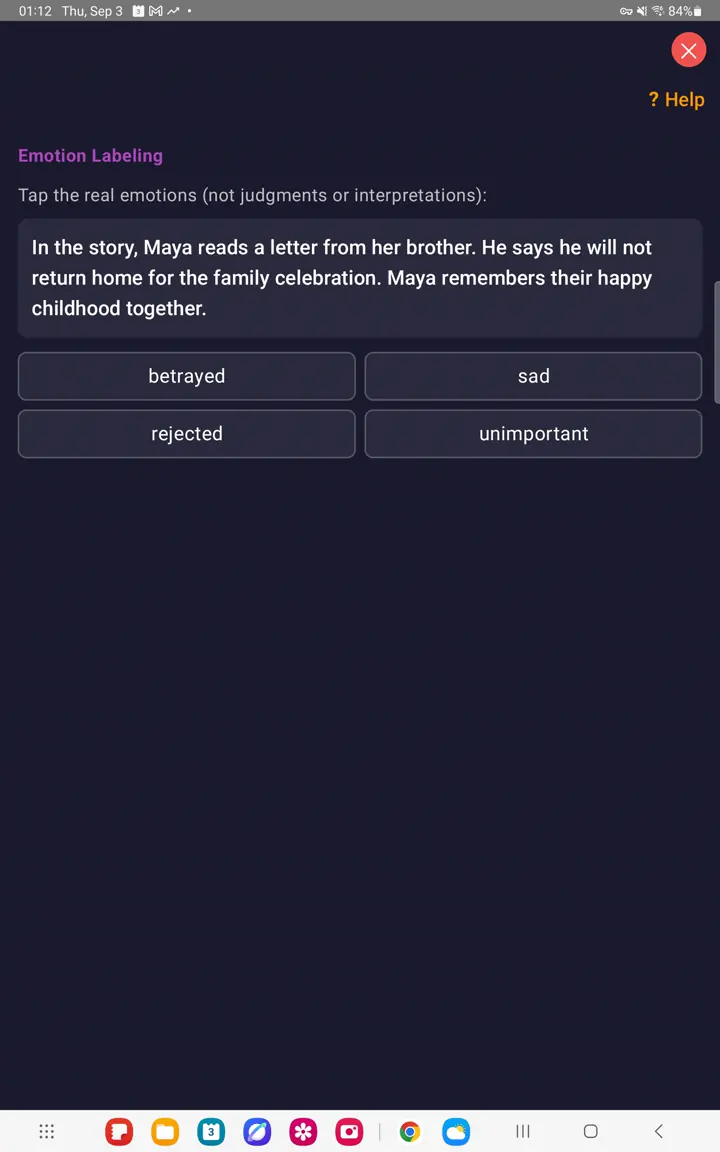
#26 Emotion Labeling learning and check
If you can name it, you can tame it. Students build a rich English vocabulary for feelings — beyond happy and sad into frustrated, relieved, overwhelmed. Scenarios ask them to label what a person is feeling and why.
Draws on: Emotional granularity — fine-grained feeling vocabulary — supports regulation, and emotion words differ across languages (Barrett 2006; Pavlenko 2005).
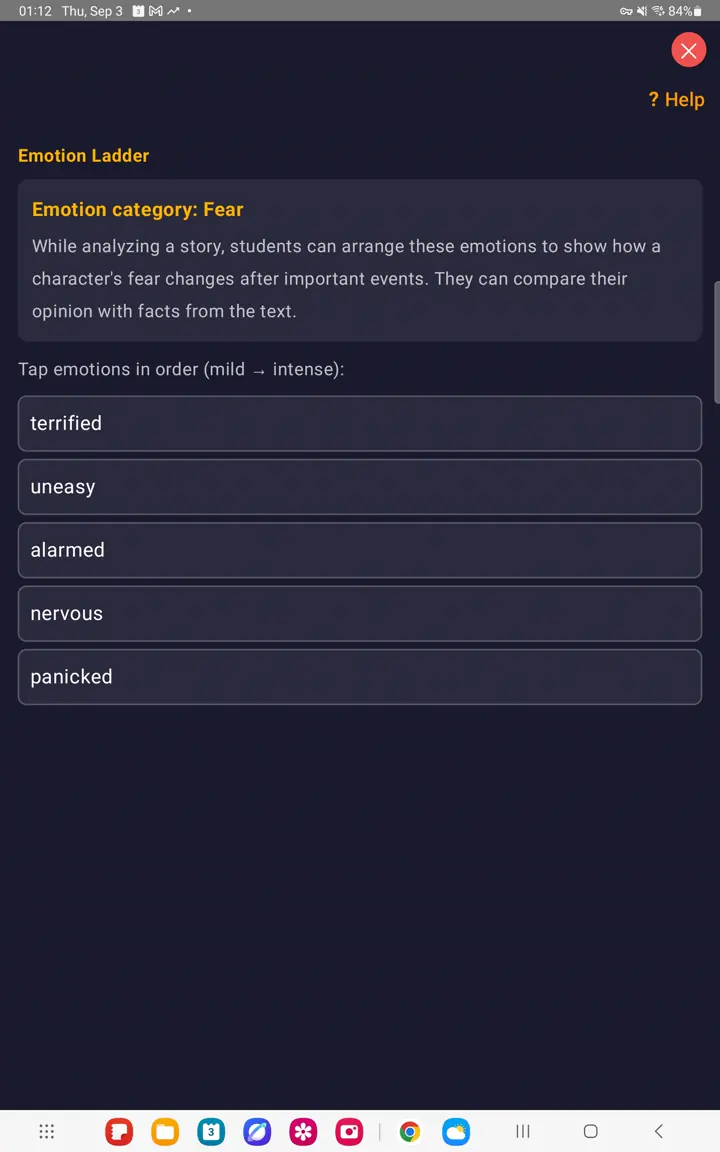
#27 Emotion Ladder learning and check
From annoyed to furious: order the intensity. Students arrange emotion words by intensity — annoyed, irritated, angry, furious — and pick the precise rung for a described situation. Precision in feeling words is precision in self-understanding.
Draws on: Recognizing emotional intensity gradations is a core component of social-emotional competence (Denham 1998; CASEL framework).
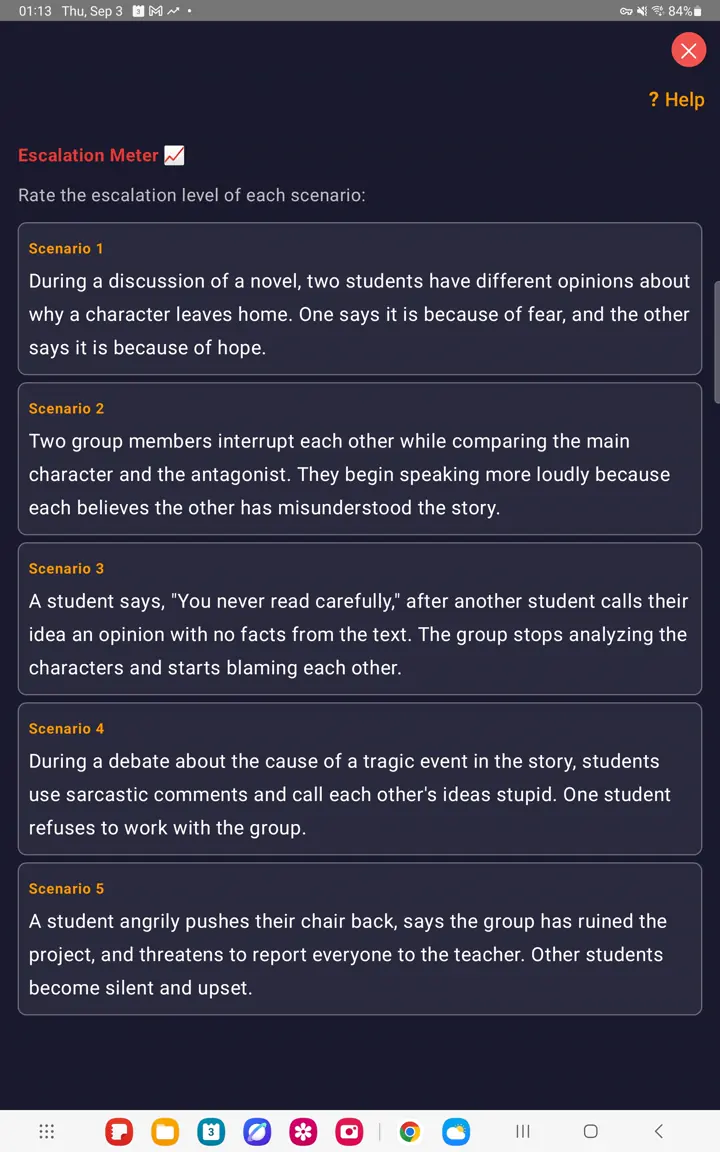
#31 Escalation Meter learning and check
Watch the conflict heat up — and cool it down. Students track a dialogue as it escalates, marking the moments where temperature rises and choosing lines that would de-escalate instead. Conflict dynamics become visible and manageable.
Draws on: Recognizing escalation triggers enables timely emotion regulation, the antecedent-focused strategy shown most effective (Gross 2002).
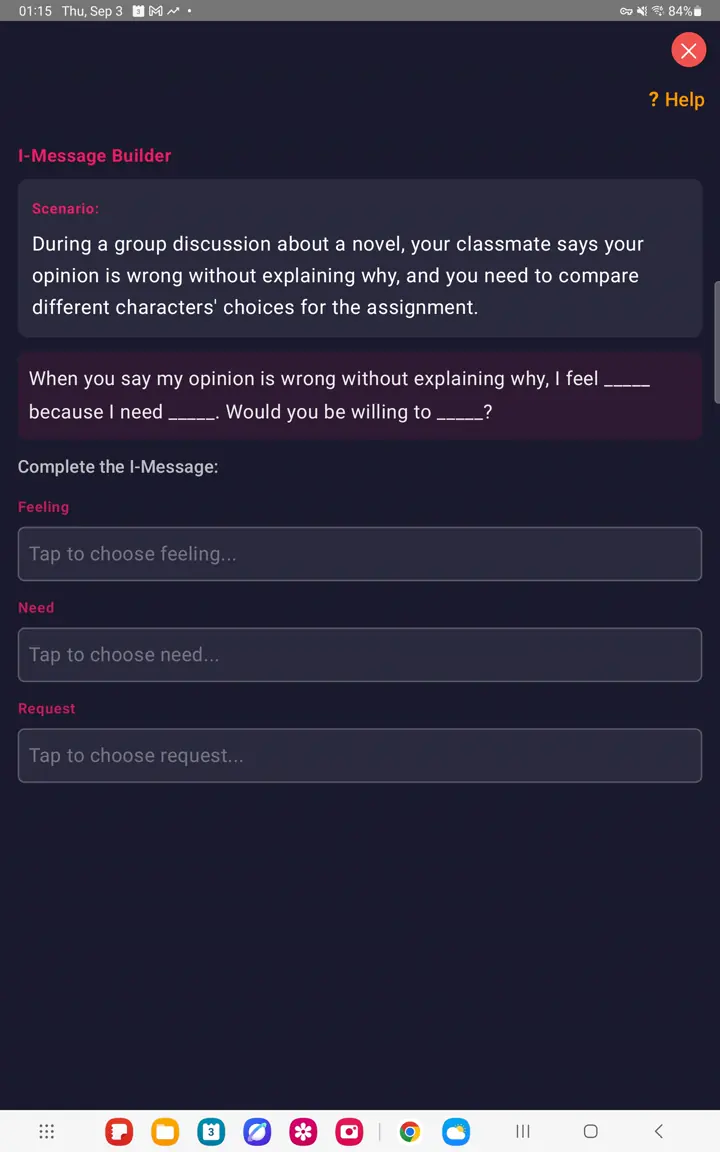
#38 I-Message Cloze learning and check
Turn "You always..." into "I feel...". Students complete and build I-messages: "I feel X when Y, because I need Z." The formula of nonviolent communication is rehearsed in English, in a low-stakes game setting.
Draws on: I-statements reduce defensiveness and de-escalate conflict (Gordon 1970; Rosenberg 2003, Nonviolent Communication).
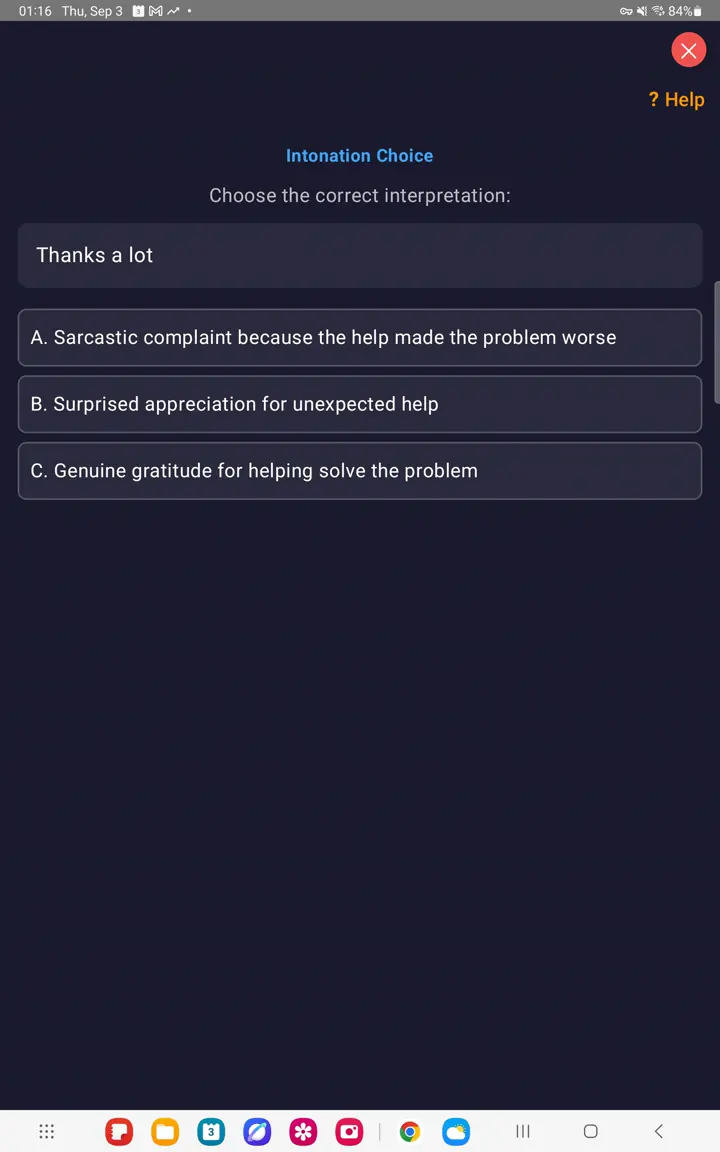
#41 Intonation Choice learning and check
It's not what you said — it's how you said it. Students hear the same sentence delivered with different intonations and judge which one fits the communicative goal: support, sarcasm, genuine question. Tone becomes a conscious choice.
Draws on: Prosody carries pragmatic and emotional meaning that often outweighs the literal words (Chun 2002; Scherer 2003).
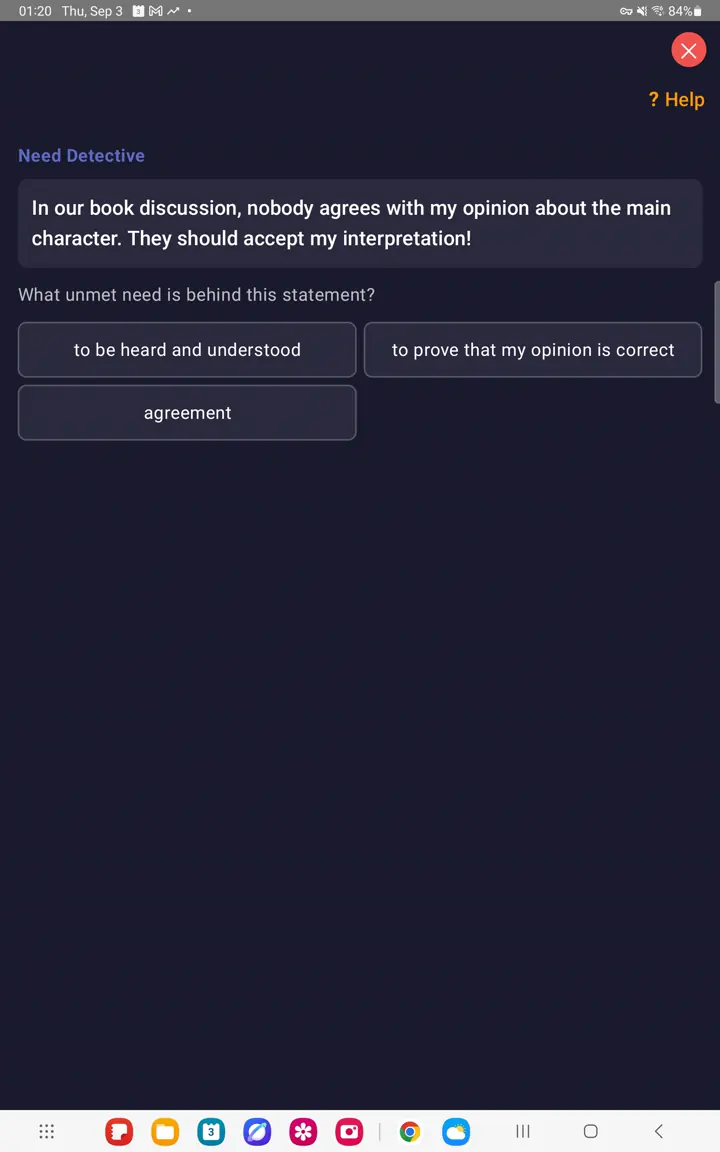
#57 Need Detective learning and check
Behind every feeling hides a need. Find it. Students read emotional statements and deduce the unmet need behind them: security, respect, autonomy, connection. Looking for the need behind the words is a core move of nonviolent communication.
Draws on: The feelings-as-signals-of-needs model is the heart of Nonviolent Communication (Rosenberg 2003).
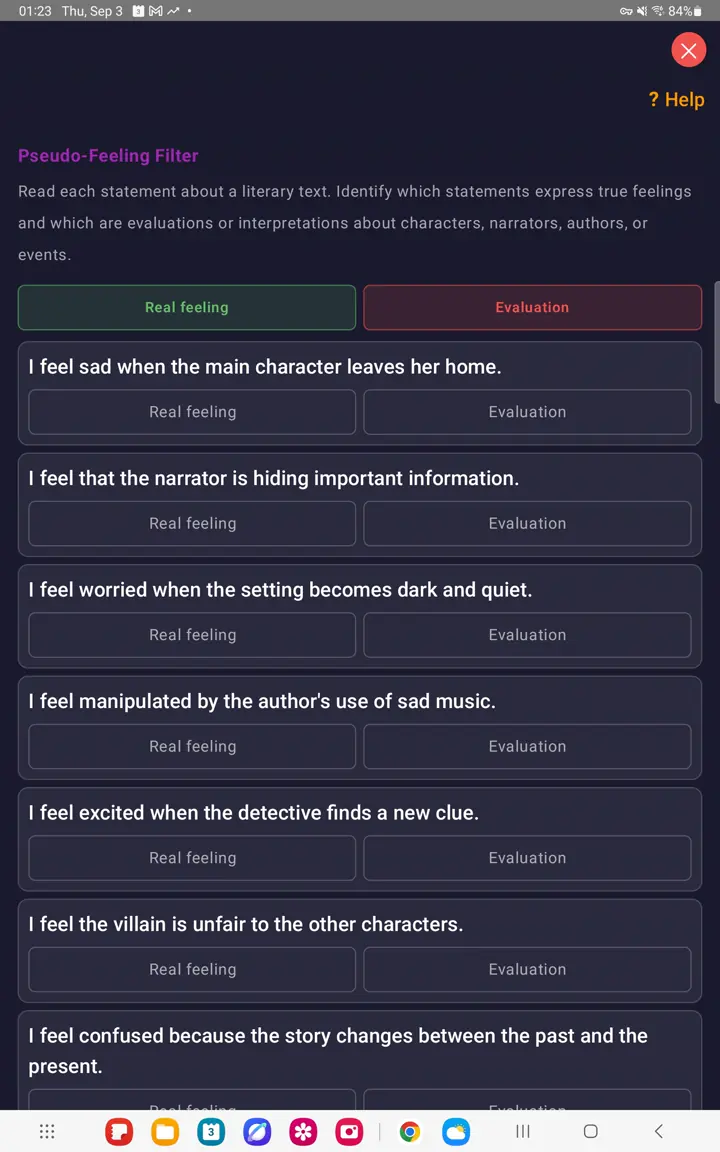
#70 Pseudo-Feeling Filter learning and check
"I feel ignored" is not a feeling — it's a verdict. Students learn to distinguish true feelings (sad, scared, hurt) from pseudo-feelings that hide accusations (betrayed, ignored, used) — and to translate the latter into honest feeling-plus-need statements.
Draws on: Separating feelings from evaluations is a cornerstone exercise of Nonviolent Communication (Rosenberg 2003).
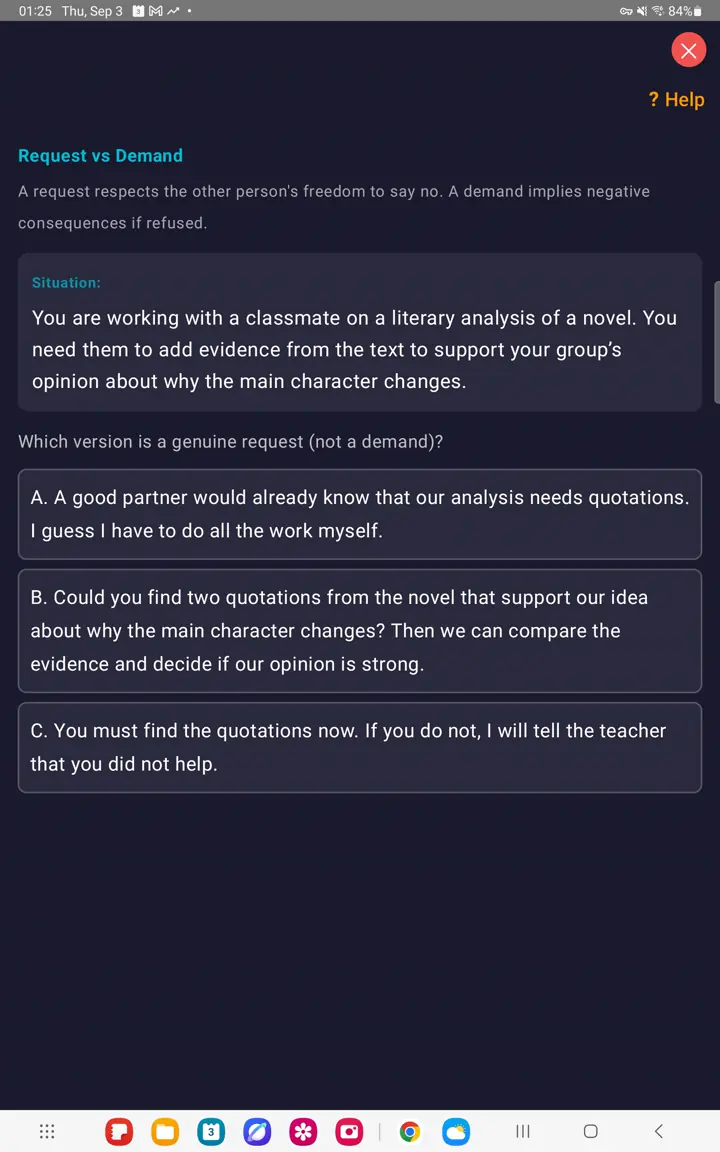
#77 Request vs Demand learning and check
A request accepts "no". A demand punishes it. Students classify and rewrite utterances: which are genuine requests and which are demands in disguise? Then they craft requests that are specific, doable and open to refusal.
Draws on: The request-demand distinction and criteria for effective requests come from Nonviolent Communication (Rosenberg 2003).